

More Than Just Splashing Fun: How Public Pools Can Help Cities Beat the Heat
More Than Just Splashing Fun: How Public Pools Can Help Cities Beat the Heat
By SMU City Perspectives team
Published 25 September, 2026
“As cities face increasingly frequent extreme heat, public pools offer an affordable and accessible means of cooling for vulnerable communities, while helping cities reduce the strain that heat-related emergencies place on healthcare systems.”
Eric Fesselmeyer
Associate Professor of Economics (Education); Urban Fellow (Urban Growth)
In brief
- Extreme heat events can strain cities’ healthcare systems by causing heat-related emergencies to spike.
- Public swimming pools can provide an affordable and accessible form of heat relief, especially for vulnerable communities.
- Public swimming pools can be an important part of a city’s broader strategy for adapting to extreme heat.
The United Kingdom (UK) recorded its fifth-hottest day on record on 13 August, with temperatures soaring past 35 degrees Celsius. Earlier, similar extreme heat was reported across Europe, with France recording its hottest day ever on 23 June. The health consequences have been severe. World Health Organization (WHO) Director-General Tedros Adhanom Ghebreyesus noted excess deaths linked to high temperatures in Europe, urging countries to “implement heat health action plans” to safeguard health. But the challenge is not confined to Europe.
Recent research in Singapore has further highlighted the health risks associated with rising temperatures. Released in March 2026, the study found that every one degree Celsius rise in daily average temperature more than doubles an outdoor worker’s risk of heat stroke.
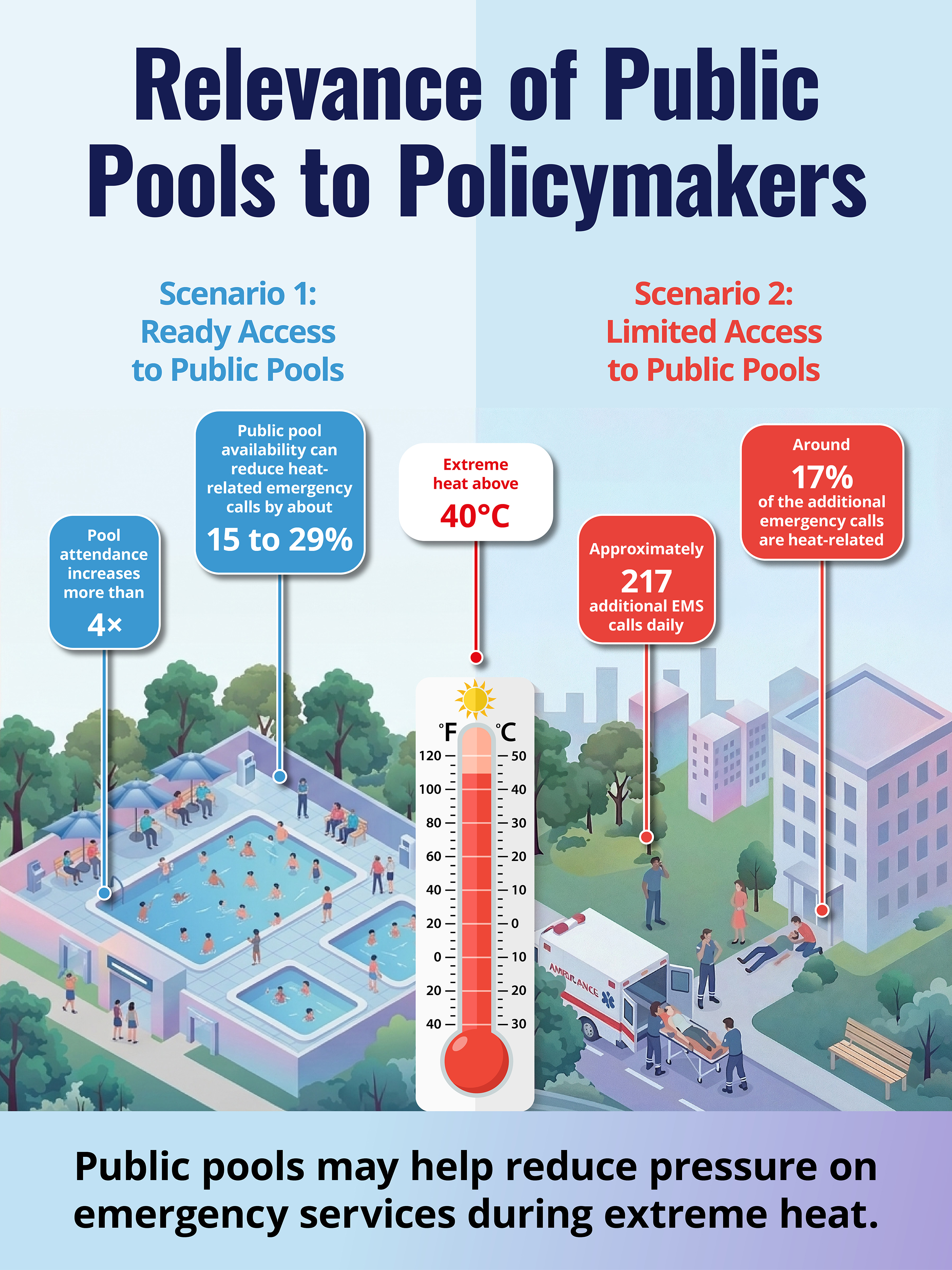
The effects are also evident at the city level. Eric Fesselmeyer, Associate Professor of Economics, found a similar relationship in his research in New York City, United States (US). “We found that when temperature spikes in an area, emergency medical services (EMS) receive about 217 additional calls daily, and around 17% of those additional calls were heat-related emergencies. That’s a clear sign that extreme weather puts real strain on EMS.”
This raises an important question: can cities do more to help their residents adapt to extreme heat?
How Cities Are Adapting to Extreme Heat
Research has linked higher temperatures to poorer sleep, more accidents, higher mortality, increased mental health emergencies, aggressive behaviour and crime, and lower productivity. For cities, the challenge is compounded by the urban heat island effect, which makes built-up areas significantly warmer than their surroundings. As urban populations continue to grow, more people are being exposed to these risks.
“Given the susceptibility of cities to the urban heat island effect and growing urban populations, there is significant incentive for them to put in place effective heat adaptation strategies,” said Assoc Prof Fesselmeyer, who is also an Urban Fellow (Urban Growth) at SMU’s Urban Institute.
Such strategies take different forms. During one of its hottest summers on record this July, Japanese authorities urged people to stay indoors, use air conditioning, drink plenty of water, avoid strenuous outdoor activities, and check on elderly people and young children who are particularly vulnerable to extreme heat.
Similar behavioural changes have also been observed in Singapore. In an earlier study, Assoc Prof Fesselmeyer found that on hotter days in Singapore, more people visit malls and choose to work in offices rather than from home. This shift towards cooler indoor spaces is also reflected in the Singapore government’s recently announced plan to open more than 300 cooling centres as part of its response to higher temperatures during heatwaves.
Governments are also exploring both long- and short-term measures to make cities more heat resilient. In New York City, for example, initiatives such as ‘MillionTreesNYC’ and ‘Cool Neighborhoods NYC’ aim to expand green cover and protect residents through measures including trees, reflective roofs and improved ventilation. Elsewhere, cities including Paris and Venice are exploring cooling tents, misting machines, drinking fountains, spraygrounds and other measures to increase access to cooler spaces.
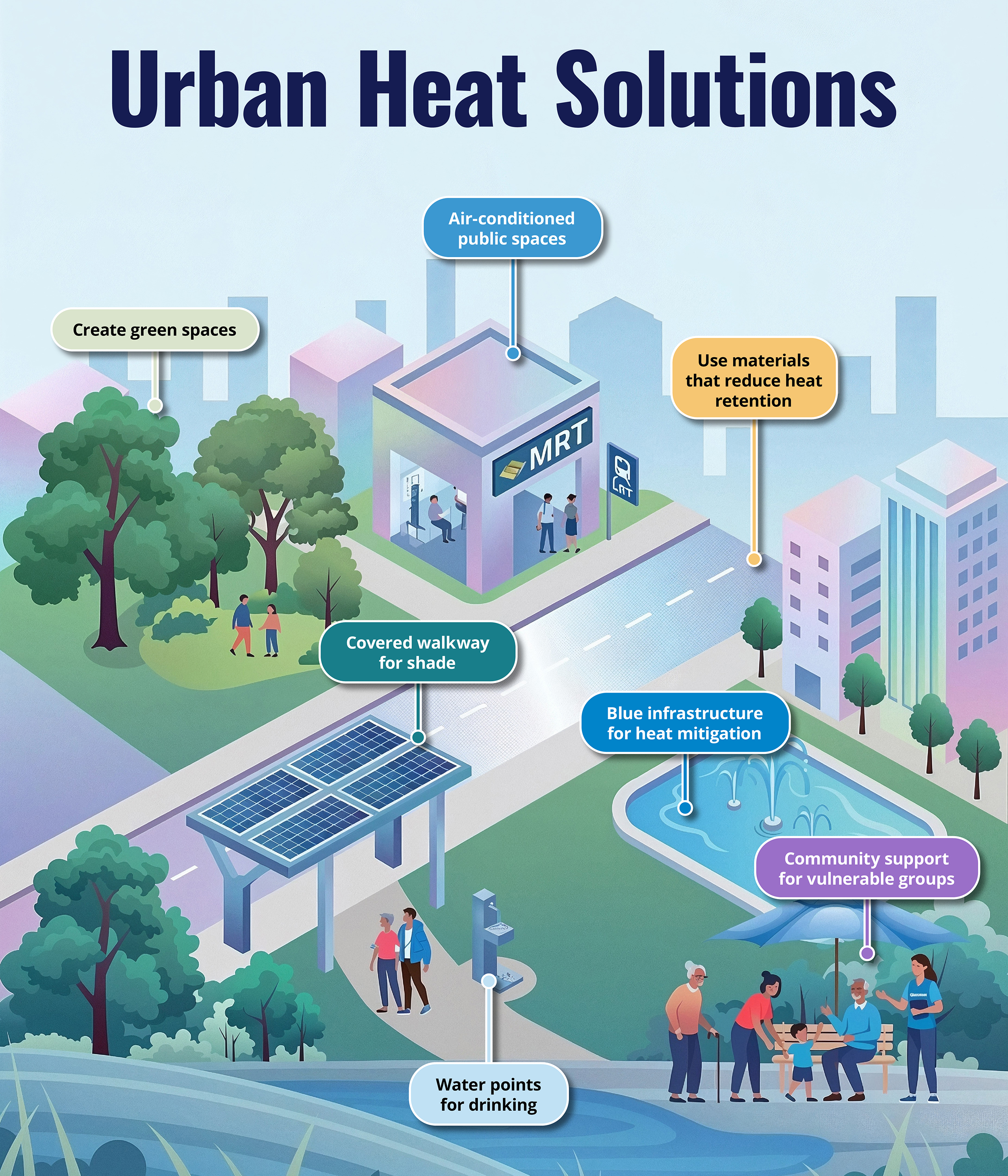
While cities recognise they need a range of measures to manage extreme heat, one potentially important piece of this urban heat-adaptation toolkit is often overlooked: public swimming pools.
The Case for Public Swimming Pools
Water has long played an important role in urban life, from rivers, lakes and canals to wetlands and other forms of blue infrastructure.
Assoc Prof Fesselmeyer’s study located in New York City found that public swimming pools can play a role in how residents cope with extreme heat. “We observed that with every degree Celsius increase, the number of people going to the public pool increases by 8%, or approximately 30 persons – and the hotter it gets, the more obvious the effect. When the temperature goes beyond 40 degrees Celsius, pool attendance increases to more than four times higher.”
The relationship is particularly striking across income groups. “We saw that pools located in low-income neighbourhoods experience the highest usage rates. When the temperature soars past 40 degrees Celsius, pool attendance increases up to 44% higher in the lowest-income neighbourhoods than in the highest-income neighbourhoods. This suggests that as the heat worsens, the most economically disadvantaged communities increasingly depend on public pools for relief,” he said. “Importantly, we also found that public pool availability can reduce heat-related emergency calls by an estimated 15 to 29% during extreme heat events.”
The pattern reveals an important fact. Low-income and other marginalised communities have less access to private cooling options, such as air-conditioning and private pools, and therefore rely more heavily on public amenities for heat relief. They may also face greater exposure to heat-related health risks because of limited green space, substandard housing, higher population densities, and other structural disadvantages.
“If we can make public pools more readily available to this group, we can potentially meaningfully ease the strain on our healthcare system during extreme heat conditions, making a strong economic case for building more public swimming pools,” Assoc Prof Fesselmeyer added.
Building More Heat Resilient Cities
The benefits of public swimming pools extend beyond just helping people cope with extreme heat, his research showed. As shared community spaces, they also encourage physical activity and social interaction. This sets public pools apart from heat-adaptation measures like subsidies for residential air-conditioning, which are only effective for protecting individual households and are also dependent on factors like housing type, appliance ownership and access to reliable electricity.
“Comparatively, public swimming pools are more inclusive. They are affordable, accessible, and therefore more likely to reach the very communities that stand to benefit most.” However, he cautioned that public pools should not be viewed as a replacement for residential cooling support or other heat adaptation measures. “Public pools do not replace residential cooling support, or any of the other heat adaptation measures. Instead, they complement other initiatives to deliver measurable health benefits during extreme heat, in addition to their recreational and social benefits.”
For cities considering expanding their pool networks, the question is not simply about how many pools to build, but where they should be located and how they should be designed.
Assoc Prof Fesselmeyer recommends that policymakers consider factors such as population density and demographics when deciding where and how many public swimming pools are needed. “It’s always a balancing act – is it better to build one big swimming pool or many small ones? Should there only be one lap pool in the complex, or also plunge pools and wading pools?”
For policymakers, these decisions become even more important as cities face changing demographics and increasingly frequent extreme heat. “Singaporeans may have a vastly different culture and value public swimming pools for different reasons from New Yorkers, but there are also similarities such as ageing populations, and increasing temperatures,” Assoc Prof Fesselmeyer elaborated.
Those shared challenges, he argued, make the case for viewing public pools as more than recreational amenities, but as part of the wider infrastructure that helps cities remain liveable in a warming climate. They can be an important part of the toolkit cities use to keep their residents safe, connected and resilient.
Methodology & References
BORSKY, Stefan and FESSELMEYER, Eric. Public pool usage as adaptation against urban heat. (2026). Journal of Environmental Economics and Management. 137, 1-24.
Available at: https://ink.library.smu.edu.sg/cis_research/467/
FESSELMEYER, Eric; LIU, Haoming.; SALVO, Alberto.; and SIMORANGKIR, Rhita P B.. Heat and observed economic activity in the rich urban tropics. (2024). Economic Journal. 134, (664), 3445-3460.
Available at: https://ink.library.smu.edu.sg/cis_research/147
BORSKY, Stefan; FESSELMEYER, Eric; and VOGELSAND, Lennart. Urban heat and within-city residential sorting. (2024). Journal of Environmental Economics and Management. 127, 1-22.
Available at: https://ink.library.smu.edu.sg/cis_research/256