

Closing the Funding Gap: How Cities Can Unlock Green Capital
Closing the Funding Gap: How Cities Can Unlock Green Capital
By SMU City Perspectives team
Published 28 August, 2026
“Debt markets are crucial for financing sustainable infrastructure and developments – and with greater cooperation between financial centres and cities at the periphery, we can unlock capabilities for these cities to raise green capital and direct it to where it’s most needed.”
Theodor Cojoianu
Associate Professor of Sustainable Finance, Singapore Management University
In brief
- Capital expenditure is the key metric for judging sustainability action; and green capital expenditure is largely funded through bonds and debt markets.
- Financial centres play an outsized role in facilitating green financing, opening up opportunities for vital collaborations between city planners, the financial sector and industries.
- The development of sustainable finance policies and national green taxonomies worldwide offer a framework for fundraising – but that has to be backed by industrial policy.
Cities are places where millions gather for work and for driving economic growth – yet city leaders often struggle to raise monies for building green infrastructure. While governments can raise trillions, only a small percentage is channelled into green infrastructure. As such, city governments need to do more to fundraise credibly for green infrastructure.
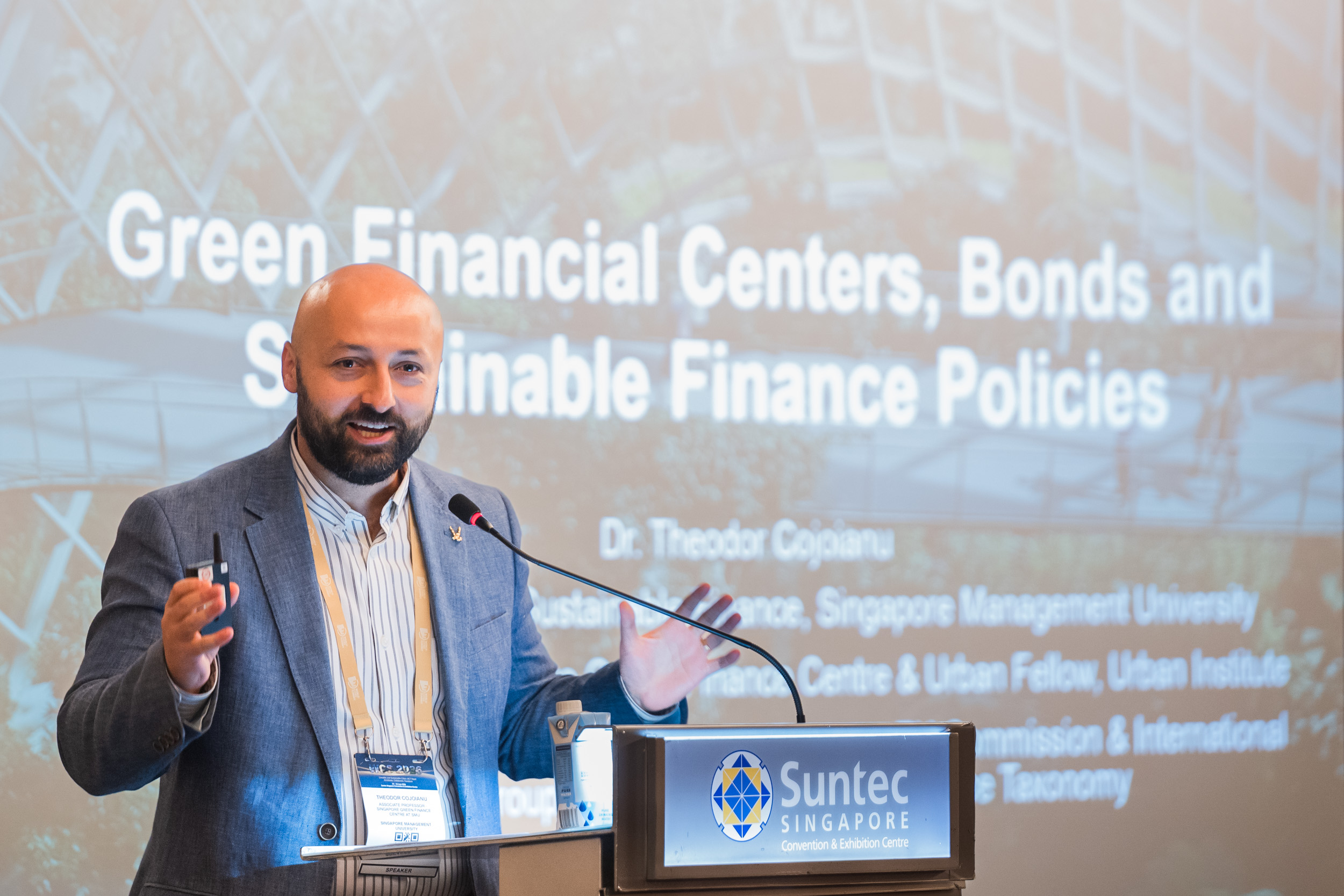
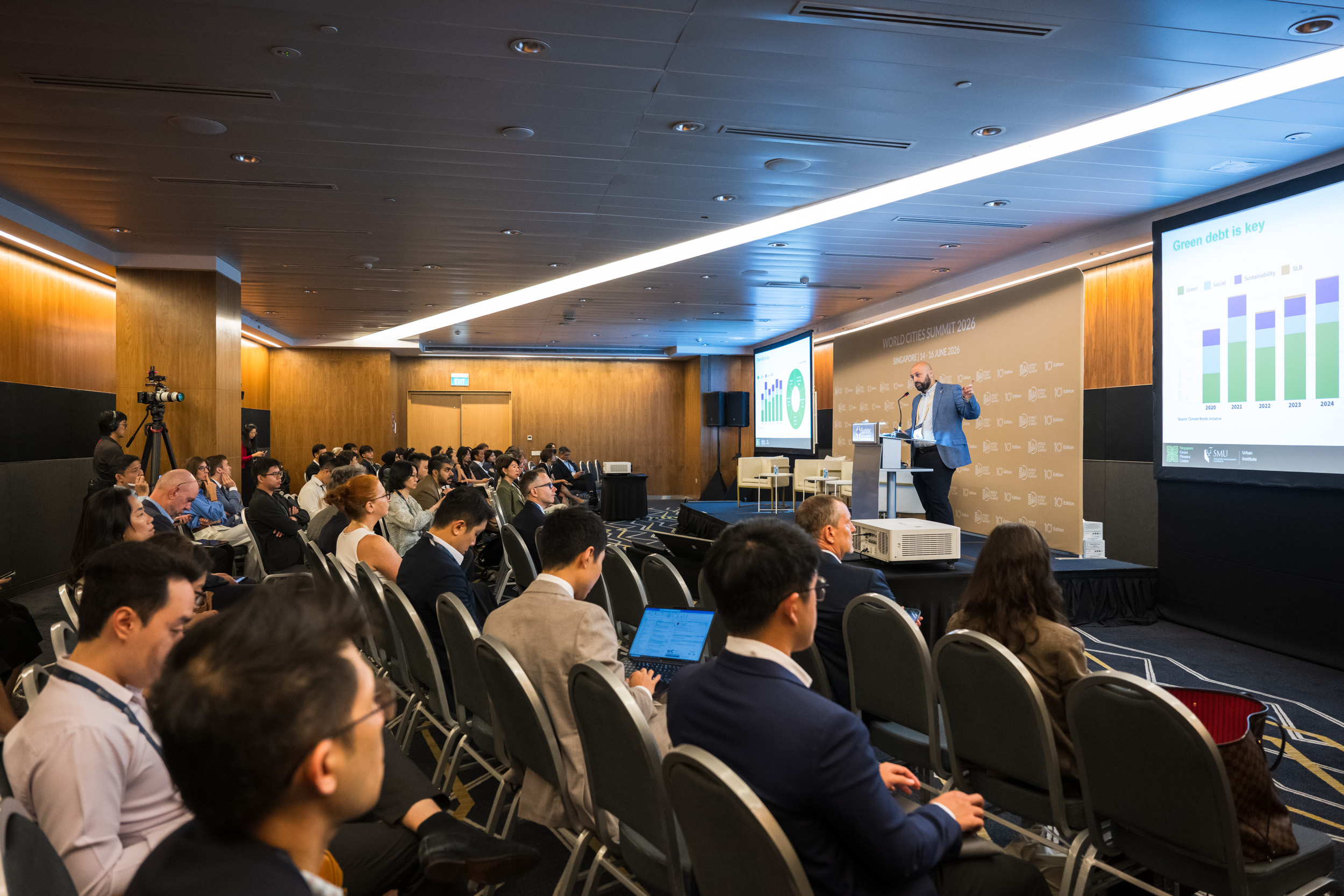
This is the view of Associate Professor of Sustainable Finance Theodor Cojoianu, in his keynote speech on “From Vision to Viability: Financing the New Urban Infrastructure Stack” during the World Cities Summit 2026. Assoc Prof Cojoianu also heads the Singapore Green Finance Centre (SGFC) at SMU as Academic Director.
Closing the Gap Between Vision and Finance
As he observed, even though municipal planners and city governments are increasingly recognising the potential for green and sustainable projects – coming up with ambitious plans, projects involving renewable energy, resilient infrastructure and waste management – they still rely on fossil fuels as their primary sources of electricity generation. “We're talking about coal in a great part of Asia, gas in the Middle East and North Africa, and only a few countries achieving renewable-based power generation,” he said.
To turn their sustainable visions into reality, especially those in developing economies, cities need access to large-scale, long-term financing. This is where the gap between plans and funding becomes stark – as cities not only have to contend with competing social and economic demands, but also struggle with election cycles, policy constraints and investment realities.
He noted that globally, there are unprecedented annual investment trends in clean energy, whether these are renewables, transportation infrastructure, or buildings, particularly in the cities; and it is vital for city leaders to show that every year they are making “the right type of investments that, in accounting terms, are showing sustained green capital expenditures.”
Making Cities Visible
To illustrate the issue, Assoc Prof Cojoianu pointed to the underlying structure of green financing. As he explained, debt markets, in the form of green bonds and green loans, are the key mechanism worldwide for financing green capital expenditure (CapEx). Around US$5 trillion of green bond issuances have been raised globally over the past six years – but only 3% was raised by local governments that are typically responsible for city-level projects.
However, he also noted that this does not mean that cities fail to get any green funding entirely. “The 3% accounts for cities and municipalities that have the capability to issue their own bonds. More often, we see that city funding is guaranteed by the central government.” City infrastructure can therefore be seen as a combination of both public and private investments. The caveat being – without the ability to fundraise or issue bonds on their own, local governments are limited by the slice of funding they receive.

Ms Nikki Kemp, Centre Director of the SGFC, also commented on the same issue during the Financing for Cities – Leadership Plenary 1, which discussed the topic of “The $Trillion Question: Why Isn't Private Capital Flowing to Cities?” Adopting a traditional finance lens, Ms Kemp observed that what typically happens is that cities fail to demonstrate financial stability and project viability to investors.
“When banks and institutional investors evaluate city-level investment opportunities, credit ratings are one of the indicators they look for. We often see ratings for companies, assets and governments – but less so for cities,” she elaborated. Without such standardised risk profiles, banks and traditional investors are less likely to view cities as viable investments.
Overcoming Structural Limits
To expand their funding sources, Assoc Prof Cojoianu posited looking at what companies and governments are already doing in the bond markets. His research identified global financial centres such as Singapore, New York and Hong Kong as key venues for green fundraising – where organisations do not just list bonds in their home countries, but also abroad.
For instance, Singapore bond issuers also invest in China, India, Japan, Australia and Brazil; with funds going toward a wide range of projects such as renewable energy, clean transportation and green buildings. “However, this ability to raise funds outside their countries is something that is missing from the toolkits of many cities – whether they are financially independent or not,” noted Assoc Prof Cojoianu.
If cities can work with financial centres for more purposeful fundraising and technology deployment networks for green finance, he said, this could boost the fundraising capabilities of cities around the world – including those in developing economies or those with limited capital markets.
Speaking a Common Language
But before that can happen, cities need to get on the same page – on taxonomies. With the growth of the green finance market, governments around the world have started on the journey of defining what’s green, with the goals of offering sustainable finance consumer protection, as well as directing capital flows towards green causes. At the moment, there are over 60 sustainable finance taxonomies around the world.
This presents additional hurdles when cities attempt to raise funds in another country – as they now have to parse through different definitions before they can list their bonds. Over at the SGFC, Assoc Prof Cojoianu and his colleagues are compiling the Sustainable Finance Taxonomy Mapper, where users can compare green finance legislations – including cities looking to list their bonds overseas.
Overall, these taxonomies offer a positive step toward understanding what constitutes a ‘green’ instrument. Such understanding is vital in the toolkit of cities raising funds for green infrastructure, his research has shown.
He explained: “We work with the European Central Bank, where we analyse over 1.5 million loans in the euro system, and we're able to further do work on our own list of infrastructure finance deals around the world. We show that polluting infrastructure, particularly those that have an impact on water ecosystems as well as protected areas are heavily penalised through credit markets. Is it enough to deter unsustainable infrastructure development? It is not. But enough to make it quite expensive to develop.”
Nonetheless, he reiterated that taxonomies are in no way a substitute for intentional policymaking when it comes to developing sustainable and resilient infrastructure.
Likewise, Ms Kemp advised keeping intentions clear and fundamentals strong, as she cautioned that having a ‘green’ label does not automatically unlock ‘new’ pools of capital. “Having that label can open access to capital that might not otherwise be accessible, such as investors who have green bond allocation targets or net-zero commitments,” she said. “But at the end of the day, capital is still coming from the same places – pension funds, institutional investors and so on. Being able to clearly demonstrate financial stability and pipeline viability – is still essential.”
Noting that cities tended to deliver on a project (or deal-by-deal) basis, which investors eschew due to expectations of large effort with relatively small returns, she mooted the idea of creating an investment-grade ‘City Infrastructure Asset Platform’ that pulls together small, city projects into tradable portfolios. “If that can happen, it would offer a whole new asset class for investors to be excited about.”
But before that – the impetus is clear. To make green fundraising more accessible to more cities around the world, financial centres have a vital role to play in collaborating with city planners, the financial sector and industries to create viable financial infrastructure. This will enable cities to successfully fundraise and deliver on their green and sustainable ambitions.