
Urbanisation vs. Heritage: The Evolving Role of Cemeteries in Asia’s Cities
Urbanisation vs. Heritage: The Evolving Role of Cemeteries in Asia’s Cities
By SMU City Perspectives team
Published 1 March, 2026
“In densely-populated cities like Singapore, but also in others like Kuala Lumpur, Bangkok, Manila or Hong Kong, cemeteries often sit at the centre because they can 2 be targets for redevelopment, repositories of family/community history and ritual practice, and offer pockets of mature trees, biodiversity and green infrastructure.“
David Ocón
Senior Research Fellow, Urban Institute in Singapore, Singapore Management University
In brief
- Both Increased urbanisation and land scarcity have led to communities valuing areas like cemeteries less.
- Cities need integrated frameworks that reflect how people actually value places.
- There are practical solutions for achieving alternative futures, including sustainable adaptations, memorialisation, compromise, and everyday sustainability.
In major Asian cities like Singapore, Hong Kong, Tokyo, Manila, Kuala Lumpur, and Bangkok, traditional cemeteries are transforming. Exhumations, clearances, and relocations are becoming more commonplace as cities prioritise infrastructure and growth. However, this trend has sparked an important dialogue about the multifaceted roles that urban cemeteries play in our cultural and natural landscapes.
Dr David Ocón has co-authored an insightful paper on this topic. In it, he explores the intertwined relationship between nature and cultural heritage in the context of regional urban cemeteries.
Instead of seeing cemeteries as resting places for the deceased, he challenges us to see them as vital green spaces that contribute to urban biodiversity and cultural memory. By bridging the gap between nature and cultural heritage, he advocates for a more sustainable approach to the development and management of these sites, one that honours the past while accommodating the needs of present and future generations.
This shift in perspective calls for a reevaluation of how we interact with our cemeteries. As cities continue to grow and change, it is crucial to recognise the rich narratives embedded in these spaces. How can we integrate and celebrate the complex heritage they represent? This is a task that requires thoughtful consideration and innovative solutions.
“I have always been drawn to cemeteries because they’re quiet, everyday places where you can see, almost in a single frame, how a city or a community manages three things at once: growth, belonging, and living systems”, says Ocón. His connection to cemeteries in Singapore deepened during the COVID-19 pandemic, a time when - as so many remember - most public spaces were shut down. Cemeteries, unlike so many other spaces, remained accessible, quiet, and socially distanced by nature. During a period of global uncertainty and a heightened awareness of mortality, cemeteries offered him a setting for reflection as well as work.
The clash between urban development, cultural identity, and ecological preservation
Beyond the practical aspect, Dr Ocón found that spending time in cemeteries during that period was also emotionally and intellectually grounding. “In our paper, we frame cemeteries as ‘multi-valued’ sites that hold cultural heritage and natural values, but in many Asian cities, the policy toolkits still treat ‘nature’ and ‘culture’ separately—so cemeteries become blind spots. Often, when development accelerates, cemeteries are often treated as being ‘in the way’: they’re exhumed, cleared, or relocated, and you can watch how those decisions reshape memory, identity, and even local ecologies,” he says.
One city that stands out in particular is Singapore. Land scarcity leads to a very pragmatic approach: cemeteries are expendable for roads, housing, or infrastructure. This poses two questions. One, what counts as heritage? And two, who decides what counts as heritage?
“In densely-populated cities like Singapore, but also in others like Kuala Lumpur, Bangkok, Manila or Hong Kong, cemeteries often sit at the centre because they can be targets for redevelopment (development pressure), repositories of family/community history and ritual practice (identity), and offer pockets of mature trees, biodiversity and “green infrastructure” (ecology)”, Ocón adds.
Entangled heritage spaces
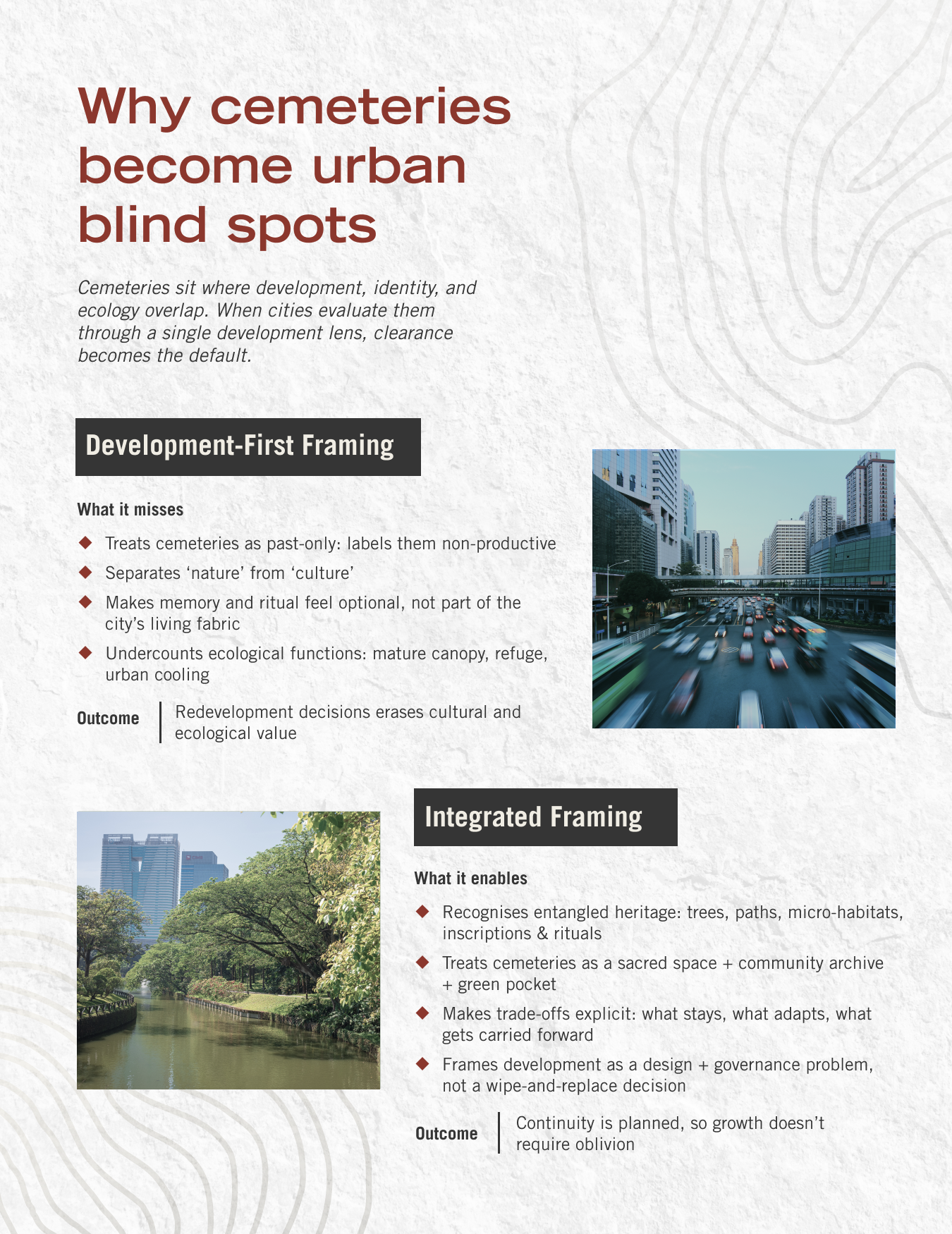
Dr Ocón’s research explores entangled heritage spaces. It refers to places where nature and culture can’t be separated cleanly. The heritage isn’t only in monuments or inscriptions but also in the trees, paths, micro-habitats, and the everyday practices that keep the place alive. One example of this is Singapore’s urban cemeteries like Kubor Kassim or Bukit Brown. They’re simultaneously sacred spaces, family archives, ecological pockets, and planning ‘land banks’, and those roles clash or overlap depending on whose lens you use.
His paper also suggests that cemeteries are often positioned as ‘spaces of the past’, which makes them particularly vulnerable to erasure. What this means is that society treats cemeteries as if they do not serve a purpose in today’s society. Once framed this way, it becomes easier to justify clearing these spaces and labelling them as ‘non-productive’ land.
Dr Ocón highlights three risks that may be present with this view of cemeteries. The first is a cultural-historical risk where the community will lose tangible links to pioneers, community lineages, and local micro-histories. Second is a social risk, this approach weakens spaces where communities practise remembrance and intergenerational continuity. Finally, it poses an ethical-civic risk, creating a norm that the dead have no claim on the city or that “the needs of the living supersede the dead”, even though cemeteries serve the living through grief and memorialisation.
In Singapore, this becomes particularly evident in the redevelopment histories around cemeteries and exhumation practices.
The dominant ‘developmentalist’ mindset
According to Professor Ocón’s paper, a developmentalist mindset views urban progress chiefly in terms of growth, efficiency, and infrastructure delivery. This perspective views land that does not directly contribute to housing figures, transport capacity, or economic output as obstacles or as land reserves earmarked for future redevelopment.
Development is not inherently a bad thing, however. In many situations, particularly in Singapore’s case, it has been essential and transformative. The city’s current prosperity and liveability is the result of difficult trade-offs and sacrifices, such as the repurposing of cemetery land to address the demand for housing, transportation, and public infrastructure. Recognising this history is crucial, as it anchors the discussion in realism rather than nostalgia or idealism.
Therefore, Prof Ocón’s paper does not argue directly against development itself, but against an understanding of development that overlooks the layered social, cultural, and ecological values embedded in certain landscapes. Instead, it proposes a series of alternative futures for regional cemeteries under pressure, based on how central they are in their communities and values:
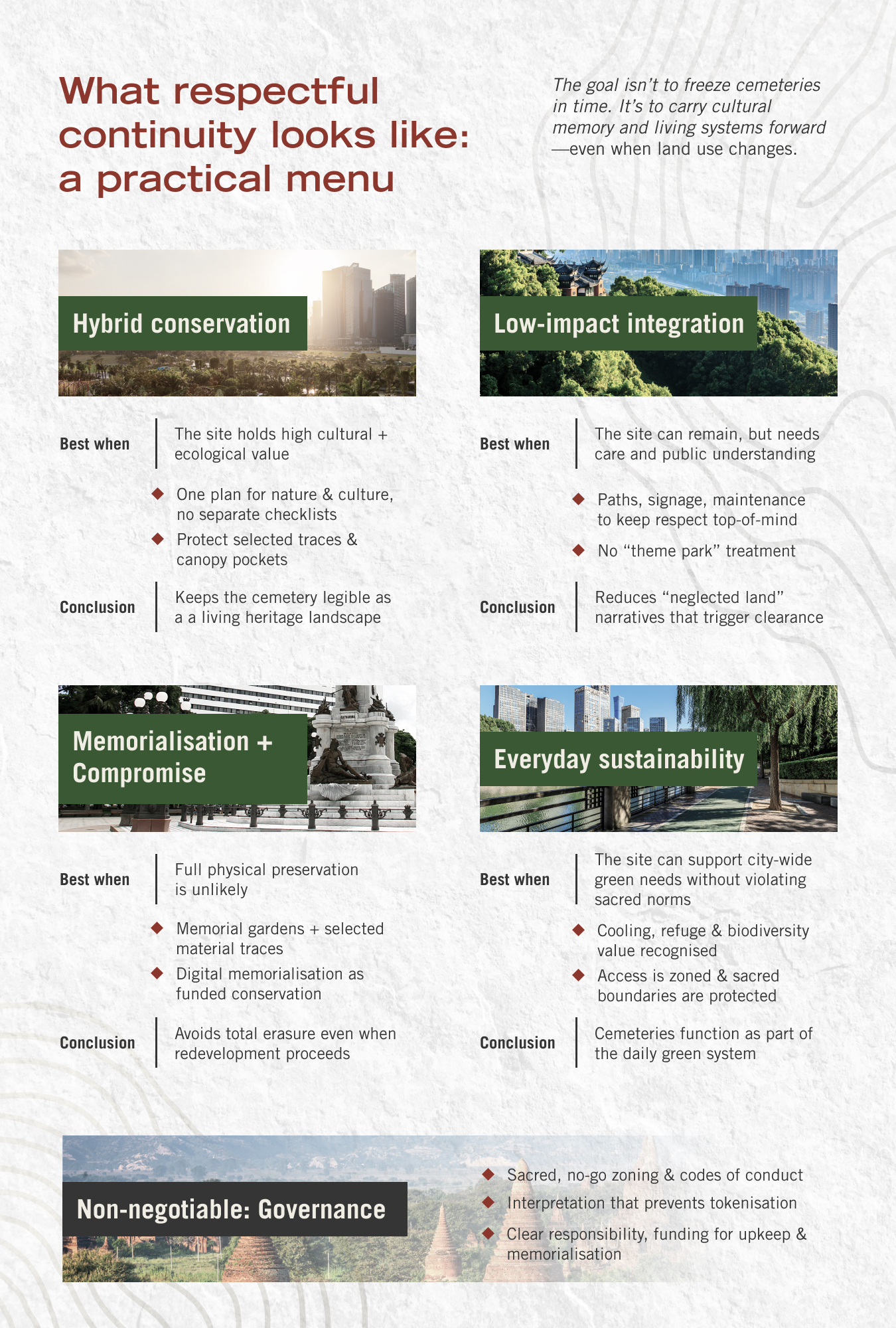
- Multi-value + hybrid conservation: Plan for nature and culture together rather than separately.
- Low-impact integration: Improve access and maintenance of these areas without ‘theme-park-ifying’ them.
- Memorialisation + sustainable compromises: Invest in dignified memorial gardens and digital memorialisation rather than total erasure of cemeteries
- Everyday sustainability: Treat some cemeteries as part of the city’s “daily green system”, for cooling, mental respite, ecological refuge. All while respecting sacred boundaries.
A more sustainable, landscape-integrated approach to cemetery design
According to Dr Ocón, this challenge isn’t uniquely local to Singapore, the difference is in the degree. Singapore’s governance capacity and planning efficiency can enable more deliberate ‘integrated’ models—if cemeteries are reframed as multi-valued landscapes rather than leftover land. His paper proposes alternative approaches to regional cemetery design that could incorporate a more landscape-integrated approach.
- Sustainable adaptations (cemetery-as-park, carefully managed): Lower-impact improvements—paths, signage, benches—so people can enter respectfully and understand what the place is.
- Memorialisation + sustainable compromise: Curated memorial gardens that preserve stories and selected material traces; and when physical survival is fragile, digital memorialisation as a serious, funded conservation strategy, not an afterthought.
- Everyday sustainability: Treat parts of cemeteries as everyday green infrastructure, cooling, ecological refuge, contemplative space, possibly even and where culturally acceptable, designate unused burial space for careful urban farming.
“The key is governance: zoning for sacred/no-go areas, codes of conduct, and interpretation that prevents tokenisation or disrespect: because without contextualisation, preservation becomes symbolic rather than meaningful.”
Many of these sites are becoming increasingly threatened by land scarcity or redevelopment. If this trend continues, multiple things are at stake.
Memory will be forgotten, from names and family trees to migrant histories and vernacular inscriptions. Identities won’t be as rich as they used to be, as the city becomes less textured and belonging becomes curated rather than lived. Green pockets that can act as buffers and refuges in dense urban fabrics will disappear.
On a more philosophical level, removing these sites also normalises the idea that remembrance has no value; that the past is part of our present. Cemeteries aren’t places where we simply bury those that passed, but rather places that hold memories and culture. Two things that make up human identity. “Cemeteries are not just ‘land banks’: they are multi-valued landscapes. The goal isn’t to freeze cemeteries in time—it’s to design respectful continuity, so development doesn’t require oblivion.”
Methodology & References
OCÓN, David, & YOUNG, Wei Ping.(2024). Bridging the nature-cultural heritage gap: Evaluating sustainable entanglements through cemeteries in urban Asia. Sustainability Science, , 1-20.
Available at: https://ink.library.smu.edu.sg/soss_research/3962