
Resident, Wildlife or Pest? How We Categorise Urban Wildlife Decides their Fates in Our City
Resident, Wildlife or Pest? How We Categorise Urban Wildlife Decides their Fates in Our City
By SMU City Perspectives team
Published 17 August, 2026
“Many cities aspire to enhance biodiversity by creating biophilic urban environments, but greater biodiversity also means living alongside urban wildlife, and the need to design for equitable biophilic co-existence.”
George Wong
Assistant Professor of Sociology (Education); Urban Fellow (Urban Experiences) Basket; Coordinator for Asia Insights
In brief
- Building a truly biophilic city requires recognising that coexistence between humans and urban wildlife is shaped by political, cultural and governance decisions.
- As public attitudes, socio-cultural values and policies evolve, an animal's status – and ultimately its chances of survival and experiences in the city – changes over time.
- The Urban Crittizenship Framework explains how policy, public perception, governance, and advocacy shape whether species are treated as ‘residents’, ‘wildlife’ or ‘pests’, and can be applied across different contexts.
On 22 June this year, a critically endangered hawksbill turtle was spotted at East Coast Park attempting to nest. It was tagged and safely released back into the waters, with National Parks Board (NParks) encouraging members of the public to support sea turtle monitoring efforts through its Biodiversity Beach Patrol.
Just over a month earlier, on 6 May, a two-metre-long crocodile spotted in the waters off Sentosa Cove was captured and euthanised.
Both are marine wildlife in the city. Yet, their fates could not be more different. As Singapore works towards its ‘City in Nature’ vision as part of Singapore Green Plan 2030, these contrasting outcomes raise a deeper question: which animals have the right to the city, and who decides?
According to George Wong, Assistant Professor of Sociology (Education), the answer lies in the complex interplay of the urban milieu, urbanites’ socio-cultural values, and the policy and governance frameworks that inform urban wildlife management.
“The current approach that most cities adopt towards wildlife is very much determined by factors such as whether the wildlife is perceived as a threat to human residents or how it is classified under existing legislation. For example, if an animal is considered a threat to public safety or classified as a pest, then actions like culling are generally accepted, although in a different city, treating the same animal in such ways can cause a public uproar,” he explained. “This shows that different urban policy environments change and shape how urban wildlife are treated, and ultimately, their chances of survival and urban experiences of coexistence.”
Who Gets to Belong?
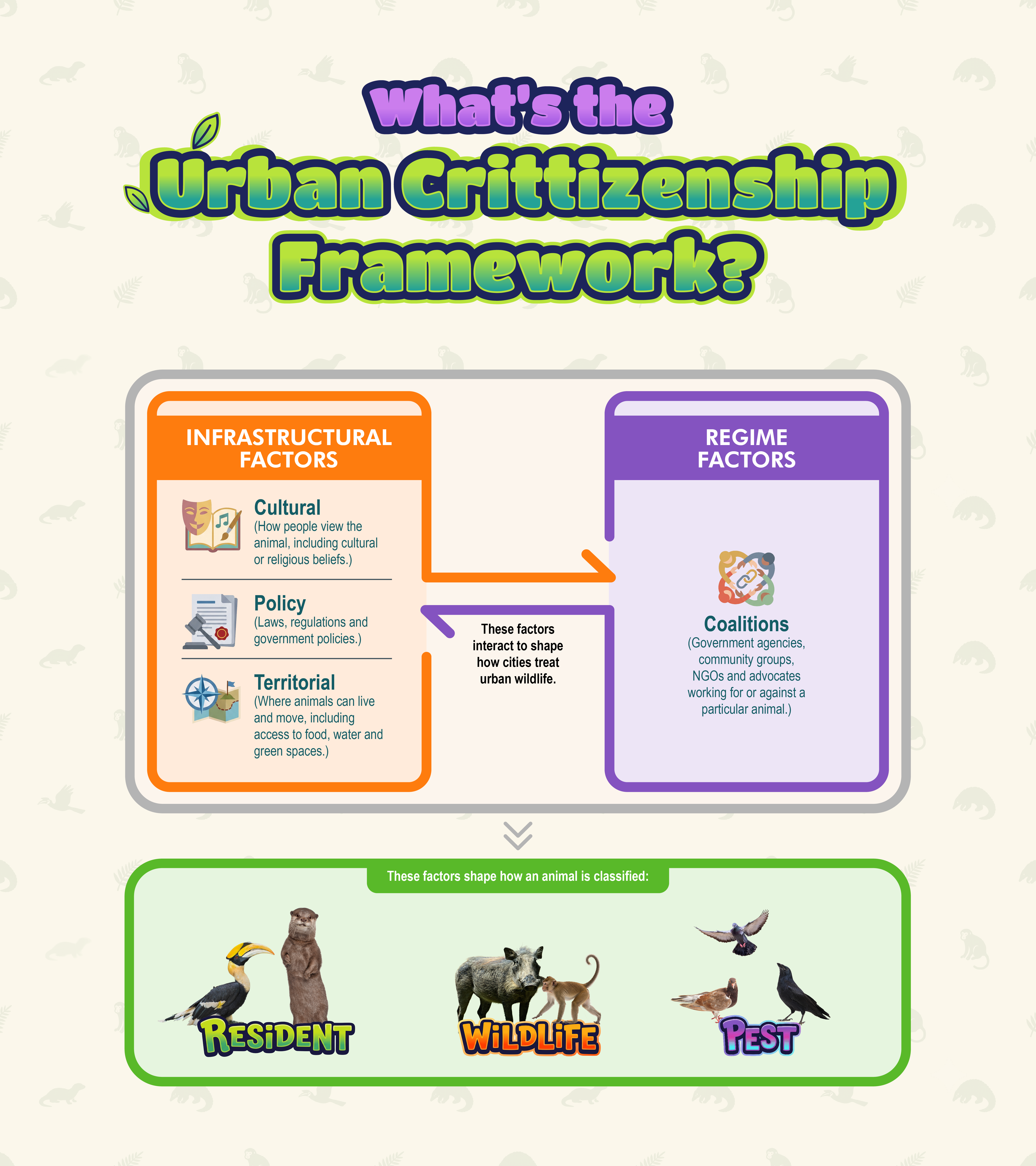
To better understand why different species are treated differently, Asst Prof Wong developed the Urban Crittizenship Framework (‘Crittizenship’, inspired by the word ‘critters’, suggests that urban citizenship extends beyond humans). The framework explains how urban animals come to be regarded as ‘residents’, ‘wildlife’, and ‘pests’, and how these categories shape the way urban wildlife is treated in cities. “My goal was to develop a framework that spotlights these different approaches and ask ourselves how we arrive at different logics and actions for different urban animals.”
Under the framework, urban animals are broadly grouped into three categories. 'Resident' animals enjoy a privileged status. They are viewed favourably by the public, are well protected under current legislation, and can generally roam freely. “Otters are an example of an animal with ‘resident’ status. They are protected under specific policies that were recently introduced,” Asst Prof Wong said.
Otters enjoy an almost celebrity-like status in Singapore. Dedicated watch groups track their movements, social media users share their sightings, and their likeness appears on stickers, keychains and plush toys. This public affection is also reflected in how conflicts involving otters are managed. The response to incidents involving valuable koi fish and parkgoers has focused on advising residents to secure their ponds and avoid approaching the animals, rather than removing the otters.
In comparison, animals classified as 'wildlife' such as wild boars are protected only within designated spaces. In Singapore, measures such as exclusion fences and cattle grids are used to discourage them from venturing into residential estates. When they move beyond these designated spaces, they are often considered intruders and may be relocated or culled. Finally, 'pests' are typically exterminated as part of urban sanitation management.
Asst Prof Wong, who is also the Urban Fellow (Urban Experiences) at SMU’s Urban Institute, added, “I don’t think we will ever reach a point where all faunas are equally valued in the city, and that is the reality. But we should at least understand why some lives are valued more than others, and the socio-political contexts in which those values are formed.”
The contrasting fates of the hawksbill turtle and the crocodile in recent incidents are therefore not isolated. Rather, they reflect the political, cultural and policy decisions that shape urban wildlife’s right to the city.
Who Gets to Decide?
With so many factors in play, these categories are malleable and always up for debate. As public perception, socio-cultural values, policy and advocacy evolve, animals can shift between categories, although exactly when and how remains uncertain.
Using otters as an example of how these factors can come together to shape an animal’s status, Asst Prof Wong shared, “Amidst the return of otters from Malaysia to Singapore due to habitat changes, the stakeholders redesigning Bishan-Ang Mo Kio Park through the Public Utilities Board’s (PUB) Active, Beautiful, Clean Waters (ABC Waters) Programme were trying to find an icon to represent the biophilic success of the project.
Then came along a conservation group petitioning for otters to become a biodiversity icon, which was later endorsed by the Second Minister for National Development Desmond Lee then, just as otters were gaining prominence in Bishan-Ang Mo Kio Park. The confluence of these factors all worked in the otters’ favour, helping to cement their ‘resident’ status’ over time. Otters have now become part of how we celebrate Singapore’s biophilic impact through bioengineering and conservation efforts.
The situation for pigeons, however, is markedly different. Widely regarded as disease carriers, they are managed primarily as a public health concern. NParks advises the public not to feed pigeons, buildings install netting and spikes to deter them, and those caught feeding pigeons can face fines or even jail terms for repeated offences. Despite advocacy efforts by groups such as the Urban Birds Initiative Singapore, pigeons continue to be classified as pests and culled in the Singapore context.
“These examples show that policy shapes public perception. In Singapore’s context, the government also responds to public sentiment and engages the public on these issues, meaning public perception also influences policy. Depending on who is leading the conversation, laws can change, advocacy can gather momentum and an urban animal’s status can change over time,” Asst Prof Wong said.
He added, “This is where the Urban Crittizenship Framework becomes useful. It gives activists a way to make sense of the different forces at play, while helping them identify how conversations, policy and governance can be shaped to support the urban animals they care about.”
The sika deer in Nara, Japan, are an example of how this framework can help cities consider how to change the fates of urban wildlife through image or role rehabilitation/changes. “The sika deer in Nara are now regarded as tourism assets, and this may pose issues to their lives as Japan manages over-tourism. Urban Crittizenship allows conservation and protection groups to consider how transformations to their cultural status may help promote better animal management for sika deer beyond tourism considerations,” he said.
Building Truly Biophilic Cities
While the framework was developed from Singapore’s experience, Asst Prof Wong believes its value extends far beyond the city-state. “Different cities have different circumstances, and we don’t have to look far. Just across the causeway from Singapore, Johor Bahru, Malaysia, otters are considered just an ordinary animal out of many in their wildlife ecosystem,” Asst Prof Wong said. “But whatever the case, the Urban Crittizenship Framework applies as informed by the urban cultural or policy context, whether it’s an activist in Singapore, a policymaker in Nara, Japan, or a community organisation in Bangkok, Thailand.”
Asst Prof Wong believes that recognising every city has its own unique ecosystem and politics of biophilia is a critical step towards building true biophilic coexistence. “If we want to ensure that the animals we care about have access to certain spaces and that policies are in place to protect them, we first need to recognise the different dynamics at play. In some cities, the socio-cultural dimensions are a lot more powerful than the political ones, while in others, governance or infrastructure may play a bigger role. We also need to remember that ecosystems are never static. Policies, politics and situations are constantly changing. As they do, the factors shaping how urban wildlife is treated will evolve too.”
Biophilic coexistence is therefore not just an ethical issue but also a political equation. Asst Prof Wong cautioned, “There are perspectives which we recognise as ethical, but policies may not always reflect those because there are other considerations that may supersede such considerations. To change the materiality of people's and animals' lives, politics must be the arena where these things are worked out.”
Ultimately, Asst Prof Wong sees the framework as a starting point for broader conversations about what it truly means to build biophilic communities in cities, from how cities govern wildlife and manage interspecies interactions, to how they design coexistence in shared urban spaces. “The framework is positioned to provide an opportunity for urbanites like you and me to realise that there’s so much more to biophilic coexistence. Wildlife doesn’t exist only in green urban spaces. They are also in our water bodies such as reservoirs, seas and rivers, as well as our buildings and infrastructure. It’s important to have a holistic appreciation and, despite increasing research on blue and brown spaces in recent years, we have only just scratched the surface.”
The Urban Crittizenship Framework helps to encourage new approaches to inclusion, said Asst Prof Wong, making more meaningful forms of biophilic coexistence possible. “The city is a complex and diverse ecosystem, and we need better ways of understanding what inclusion and coexistence look like, and how urban infrastructures and relations may need to adapt so that we can produce the kinds of biophilic impact we hope to achieve.”
The hawksbill turtle and the crocodile may have met very different fates, but together they remind us that coexistence is never simply about wildlife. It is also about the values, policies and politics that determine who gets to belong in our cities.
Methodology & References
WONG, George. (2024). Lion City zoopolis: Urban crittizenship in biophilic Singapore.
Anthrozoös, 1-17. https://ink.library.smu.edu.sg/soss_research/3921/