

How Bad Weather Can Cloud Green Policy Decisions
How Bad Weather Can Cloud Green Policy Decisions
By SMU City Perspectives team
Published 30 October, 2026
“If policymakers can respond to changing conditions and remain true to fundamental policy direction, they can stay responsive while offering a stable environment that gives firms the confidence to make long-term green investments.”
Zhang Hong
Professor of Finance; Director, Sim Kee Boon Institute for Financial Economics
In brief
- Policymakers may adjust green subsidies in response to visible indicators such as the air quality index, without considering whether these signals reflect temporary fluctuations or fundamental shifts.
- When government policies change too much, businesses choose to adopt a ‘wait and see’ attitude to green investments, which often require substantial investments and time before they pay off.
- Greater policy certainty can give firms the confidence to make long-term green investments.
Government policies have a huge role in shaping coordinated, whole-of-nation responses to environmental challenges. Among the tools available to policymakers, subsidies can help turn promising ideas into practical solutions by encouraging investment in early-stage environmental technologies, where the wider benefits to society often outweigh the returns available to individual firms.
Yet, firms’ confidence in policy direction matters just as much as the availability of subsidies themselves. As Professor of Finance Zhang Hong and his team found in their study, uncertainty in green subsidy allocation can influence business decisions and actions, impacting green innovation and the economy in the long run. “Cleaner technologies reduce pollution, potentially benefiting everyone. But these projects are often expensive and require substantial upfront investment. This is where government subsidies can help lower the barriers for green innovation and encourage firms to undertake these investments now rather than later.”
When Weather Shapes Green Subsidy Decisions
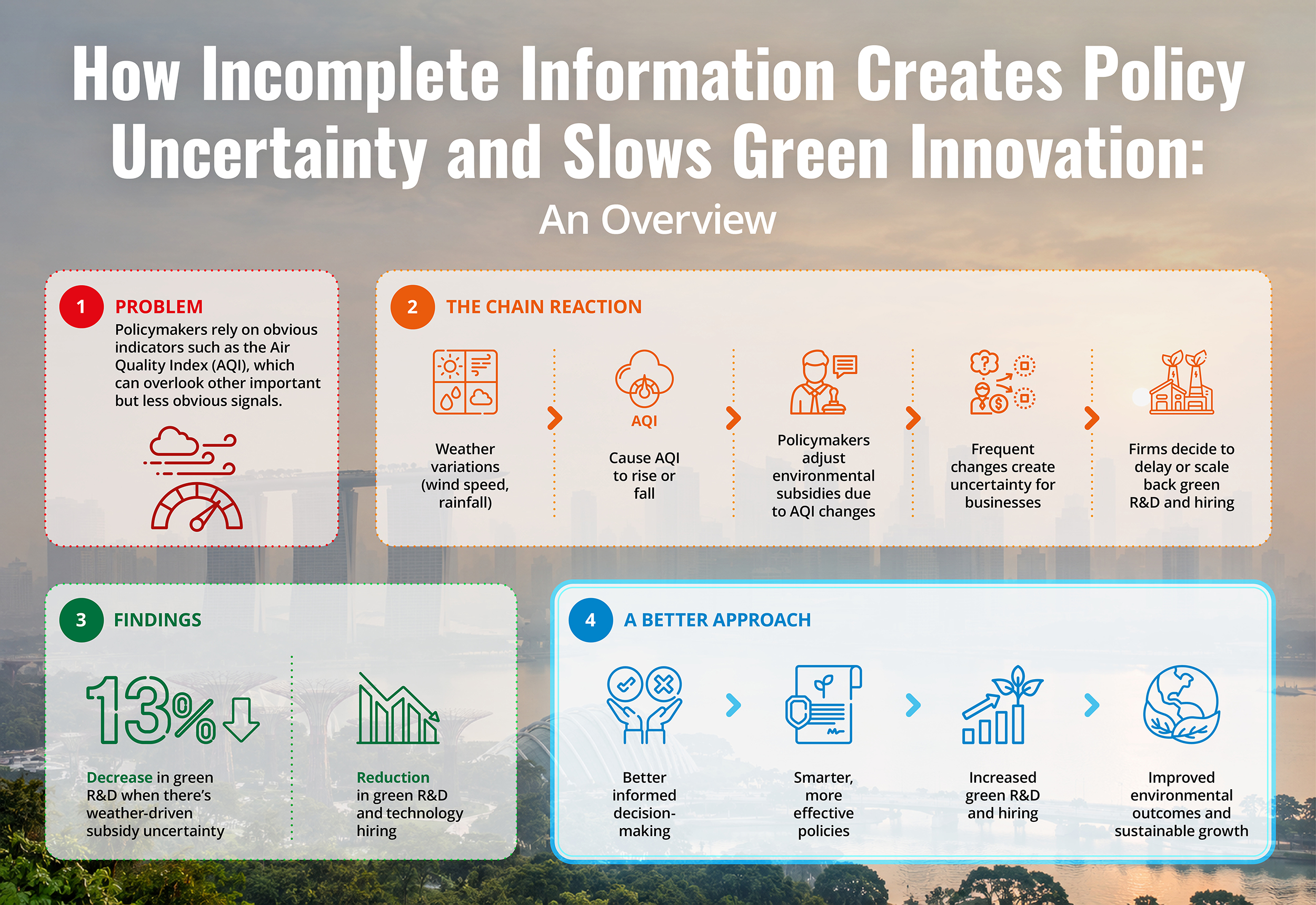
Prof Zhang and his team focused their investigation on China, one of the world’s largest manufacturing economies with many heavy carbon-emitting industries alongside a rapidly growing green technology sector. They noted that the rate of environmental subsidies was higher in the years after cities experienced worse air pollution as measured by the air quality index (AQI) – suggesting that policymakers tend to allocate green subsidies toward areas most in need of improvement, based on the recent measures of air quality.
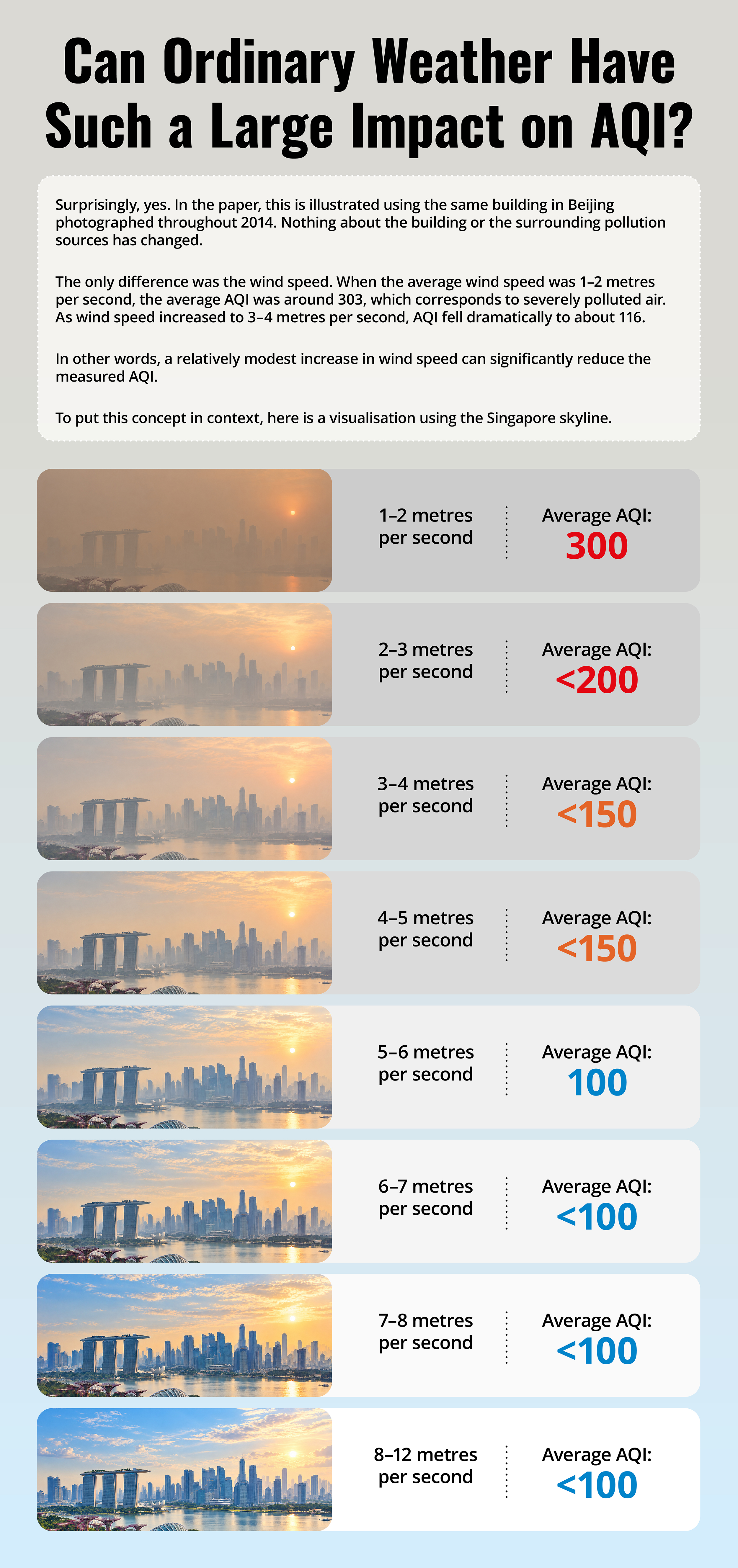
Prof Zhang said, “The central government sets environmental targets and uses indicators such as the AQI to guide the allocation of subsidies. Areas with poorer air quality may receive more support, particularly where firms can put those subsidies to effective use.” However, the team uncovered a critical gap in this approach. Short-term weather changes such as rain and wind speed can cause significant increases or decreases in AQI numbers – without meaningful changes to pollution levels or sources.
When policymakers base green subsidy decisions on short-term indicators such as AQI, subsidy rates can fluctuate from year to year, making government policies and subsidy allocations less predictable for firms. This was also reflected in the team’s conversations with Chinese firms. “They can plan green innovation investments around generous or even modest subsidies, but it’s much more challenging for them to plan when they do not know whether policies will change the next cycle.”
He added, “Environmental subsidies don’t just work to align government objectives with firms’ incentives. They have real economic importance – they influence investment decisions made by thousands of firms. Their predictability impacts whether the firms choose to invest in innovations.”
When Policy Uncertainty Slows Green Investment
This was evident in the team’s analysis of 3,168 listed firms across 352 Chinese cities from 2003 to 2019. They found that in years when a city’s wind and rainfall fluctuated more, firms headquartered in the city invested 13% less in green research and development (R&D). This is significant because government subsidies increase green innovation by about 15.8% on average. “What this shows is that policy uncertainty doesn’t result in just a small side effect. Instead, it can offset a substantial portion of the government’s intended policy impact,” said Prof Zhang.
These are often short-term but highly visible indicators with causes that are difficult to disentangle, and they create ‘noise’ that does not reflect actual environmental conditions. These can potentially discourage long-term investment in green innovation, which is often considered risky and offers uncertain payoffs. “When firms expect future subsidies to fluctuate, they postpone investment and wait for a more favourable policy environment,” said Prof Zhang.
Even well-designed subsidies can become less effective when firms are uncertain about future policy implementation. This effect is amplified among the firms that green subsidies are likely to target – these are both the green and heavily polluting sectors such as green tech, manufacturing and chemical industries. Additionally, reduced green R&D investment corresponds to a decrease in hiring for R&D and green technology roles.
This has long-term consequences. As Prof Zhang explained, “When firms choose to postpone their green investments due to policy uncertainty, new green technologies are delayed. Pollution remains high, prolonging environmental and public health effects.” In addition to increasing social costs, subsidy fluctuations can undermine the very purpose of green subsidies – which is to encourage green innovation.
Clear and Predictable Policies Go a Long Way
Nonetheless, Prof Zhang emphasised that the team does not recommend policy stability at the expense of flexibility. He believed that policies should be flexible enough to respond to fundamental changes while minimising the influence of temporary noise that can blur policy signals and create unnecessary policy uncertainty. “Responsible policymaking requires governments to adapt when fundamental conditions change – new technologies, changing environmental conditions, or evidence that an existing policy is not working all call for policy adjustments. Flexibility is not only valuable but necessary in these situations.”
As an example, Prof Zhang’s team found that the Hebei provincial government changed its target of days of good air quality from 2010 and 2020 due to unexpected episodes of bad AQI readings. These readings reflected not only changes in pollution emissions but also temporary weather conditions such as wind and rainfall. The policymakers took their cue from the changing AQI, a highly visible signal in recent memory, without understanding the underlying drivers of those signals. This had implications for the subsidies allocated to flow to the firms, resulting in policy uncertainty for green innovation.
But if and when policy adjustments are driven by fundamental changes and communicated clearly, governments can remain both responsive and predictable, supporting long-term green innovation while adapting to new challenges. Prof Zhang believes this principle applies to countries of all sizes.
He said, “Smaller countries may not always be able to compete with larger economies in terms of subsidy budgets or natural resources. But by implementing clear, scientifically grounded and predictable environmental policies, they can still become leaders in green innovation.”
Singapore provides an example of how these principles can work in practice. Prof Zhang noted that the Singapore government can maintain clear and consistent policy direction while adapting to changing circumstances. The Singapore Green Plan 2030, launched in 2021, sets out a long-term direction for climate resilience and the green economy, giving firms greater visibility of the government’s priorities. At the same time, its implementation as a living roadmap allows policies and initiatives to evolve with changing circumstances.
This balance between long-term direction and flexibility is reflected in the Green Plan’s continued development, including a major five-year review and new commitments to support green research and innovation – S$10.8 billion announced in December 2025 and another S$112 million in September 2026.
This combination of clear direction, flexibility and credible implementation could give Singapore an advantage. Prof Zhang said, “By outlining Singapore’s policy direction, it offers predictable market signals so firms can plan for long-term green investment. Add to that well-designed policies that are credible and effective, this can become a competitive advantage even for small economies like Singapore.”
The central lesson of the research is not about the size of government support, but about the quality of policy design. Whether a country is large or small, firms need confidence that environmental policies are credible, predictable, and consistently implemented in order to make long-term investments in green innovation.
As the haze in Southeast Asia is set to last till November 2026 due to the El Nino effect, it is a clear reminder to Singapore that environmental conditions can shift quickly. The challenge for policymakers is to distinguish short-term noise from meaningful change – and ensure that today’s fluctuations do not cloud tomorrow’s green ambitions.
Methodology & References
WANG, Mengyu; WURGLER, Jeffrey; and ZHANG, Hong. Policy uncertainty reduces green innovation. (2026). Journal of Financial Economics. 175, 1-14.
Available at: https://ink.library.smu.edu.sg/lkcsb_research/7772