
Constitutionalising Cities: In Conversation with Professor Maartje De Visser
Constitutionalising Cities: In Conversation with Professor Maartje De Visser
By SMU City Perspectives team
Published 2 February, 2026
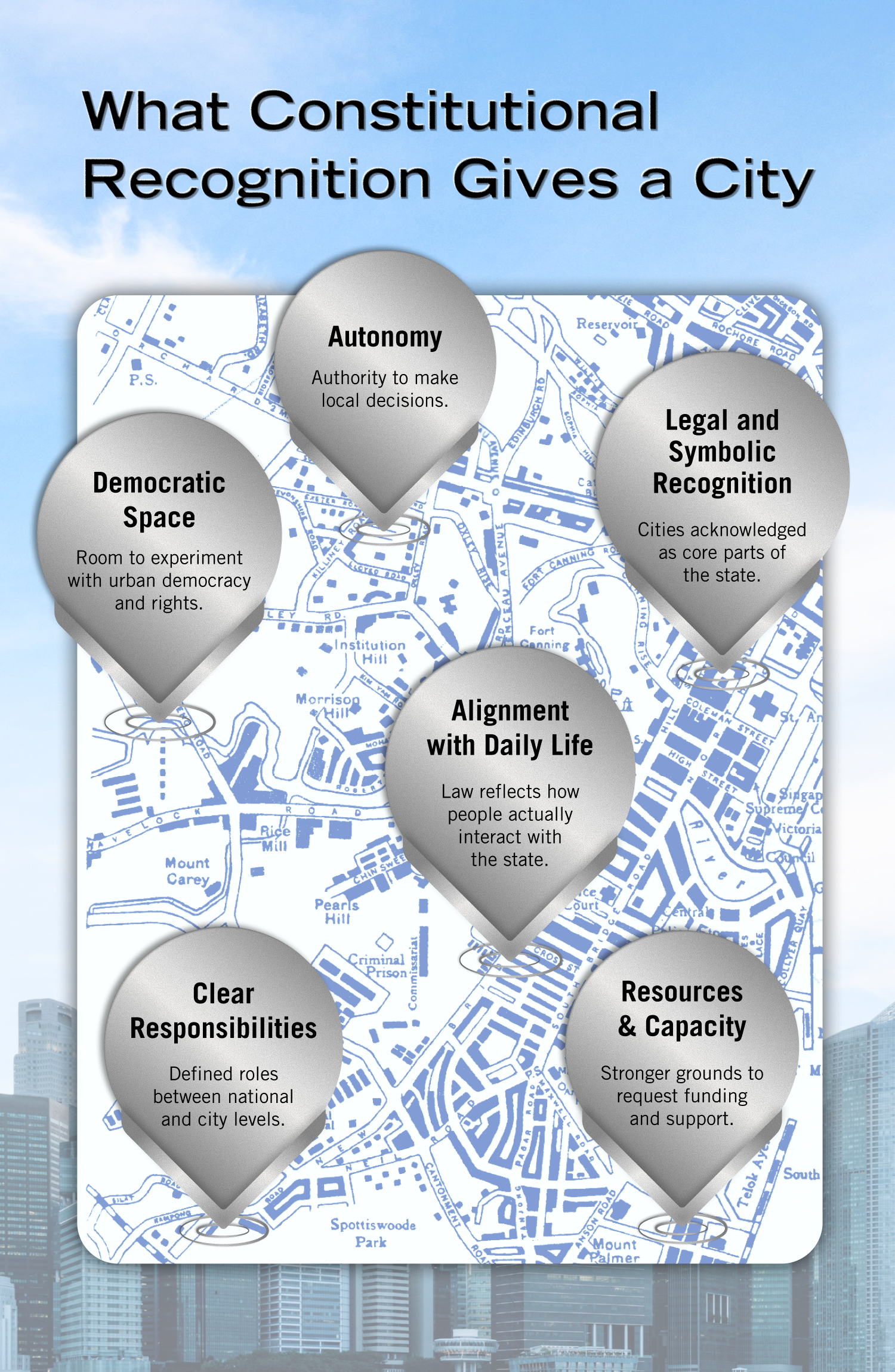
They are the last- mile in creating realities for government policies. Cities are the spaces where individuals encounter the state. Cities are social spaces and they are places where you can experiment with urban democracy and urban rights protection.
Maartje De Visser
Professor of Law at the Yong Pung How School of Law and College of Integrative Studies, Singapore Management University; Lee Kong Chian Fellow; Associate Dean (Research)
In brief
- Cities are where and how people experience the state
- Recognising cities, by constitutionalising them, would ensure that cities are better equipped to support their citizens.
- Cities and states need to operate from a place of mutual respect in order to best implement policies and support citizens.
New York, London, Shanghai, Tokyo, Paris, Bangkok - Just a few names that come to mind when thinking of the word ‘city’. These cities, however, don’t look identical. From size, to architectural design, to population makeup, these cities have their own unique identities and their own issues.
The definition of a city is not as fleshed out as one might think, and in most countries, is not inscribed in the constitution. When there is no clear definition of what cities are entitled to, this can lead to instances of cities being underfunded or underequipped to serve their citizens.
So what does it mean to constitutionalise a city, and what benefits does constitutionalising a city come with? In this article, Maartje De Visser, Professor of Law, talks about her research into how the legal architecture of cities can benefit city-dwellers because it gives them better representation, as well as assured access to services by the state.
Q: Why should legal scholars look into the constitutionalising of cities?
Prof Maartje De Visser: For me, it comes from looking at the law as a social phenomenon. Law is created in response to perceived needs or problems that exist within society that individuals or businesses face. And I think when it comes to the Constitution as the highest law of the land, we want to make sure that it is basically an accurate reflection of what we would like our society to be. I'm also researching small states, those that have a population of about one to one and a half million, and how they deal with their constitutional institutions.
What I was struck by is that cities are, for many people, a very important part of their life and identity. Yet the Constitution is often silent when it comes to cities. So there is, so to speak, a mismatch between the real practical relevance of living in an urban environment, and the way that the law actually ignores that reality. The question I wanted to explore in this paper is, if we say that the Constitution needs to be a better reflection of reality, how can the Constitution be designed in a way that allows for a good reflection of functional, flourishing, city life?
Q: What does the phrase ‘constitutionalising a city’ mean, defining it legally in that constitution or is there more to that?
Prof Maartje De Visser: That's a very good question. At its most fundamental, it's about making sure that cities are explicitly recognised and mentioned in the national constitutions or in otehr legal documents with a constitutional quality. For example, in Singapore, the Constitution mentions that there is a Parliament and that there are Members of Parliament that are elected, but it doesn't exactly say who can vote or when you forfeit the right to vote, and so on. All of that is set out in separate legislation.
Now there is even a further sense in which you can talk about constitutionalisation and that is to say the constitution is not only a legal document but it also has political, social, and symbolic functions. So when you mention a city in the Constitution it isn't only to give it legal recognition, it can also be symbolic to say we hereby signal to city administrations that the urban environment is important and urban life matters.
Q: And when you're making a document like that or similar things like that, how would you define a city?
Prof Maartje De Visser: So my research collaborator, Erika Arban, and I, basically say that you don't want to have a single legal definition that works for every single country. What qualifies as a city should be determined with reference to the local circumstances that are in existence in the country in question.
What is important is that every country reflects on this and asks itself more clearly and more deliberately what qualifies as a city and how can we best make sure that these units are given not just the recognition but also the competences and the resources to discharge their functions. That reflection ties in with this more general question about urbanisation, which concerns increasing numbers of people moving to cities, with this migration to cities having a real impact on the daily lives of all of their residents. The central government often gives cities significant responsibilities or expects cities to handle many day-to-day administrative matters but doesn't always give cities the necessary resources financially, or in personnel terms,in order to make sure that these responsibilities can actually be performed.
One of my arguments in the piece is that if you constitutionalise the city you indicate, legally and politically, that the city matters. That should make it easier for cities to call on the central government to provide them with the resources to fulfil the tasks required of them.
Q: Why don’t a lot of governments feel obligated to provide these resources to cities?
Prof Maartje De Visser: If you were to recognise the city explicitly, it means that the cities have a clearer tool to leverage their power. So, for example cities are nowhere recognised in the Dutch constitution,and it then becomes more difficult to go to the central government and say: we don't have the budget to make sure that we provide services to all the residents.
If cities are explicitly recognised in the Constitution, it gives them a basis or rationale that allows them to say: the Constitution recognises us as an important part of the government infrastructure, in the same way that the parliament or the government or the courts are given their status and competences. And just as you expect that these latter institutions get the support needed to fulfil their functions, we too should have that support.
Q: What makes a city qualitatively different from other local authorities?
Prof Maartje De Visser: In Europe, the political institutions of the European Union have come up with a definition to differentiate the urban from the rural, and in particular they use population density per square kilometre metric.
Another differentiating factor is complexity. This is the complexity of the economic and social relationships and arrangements among inhabitants, which is much higher in a city than it would be in a town or a village.
Q: How does a country, or a government, begin the process to constitutionalise a city?
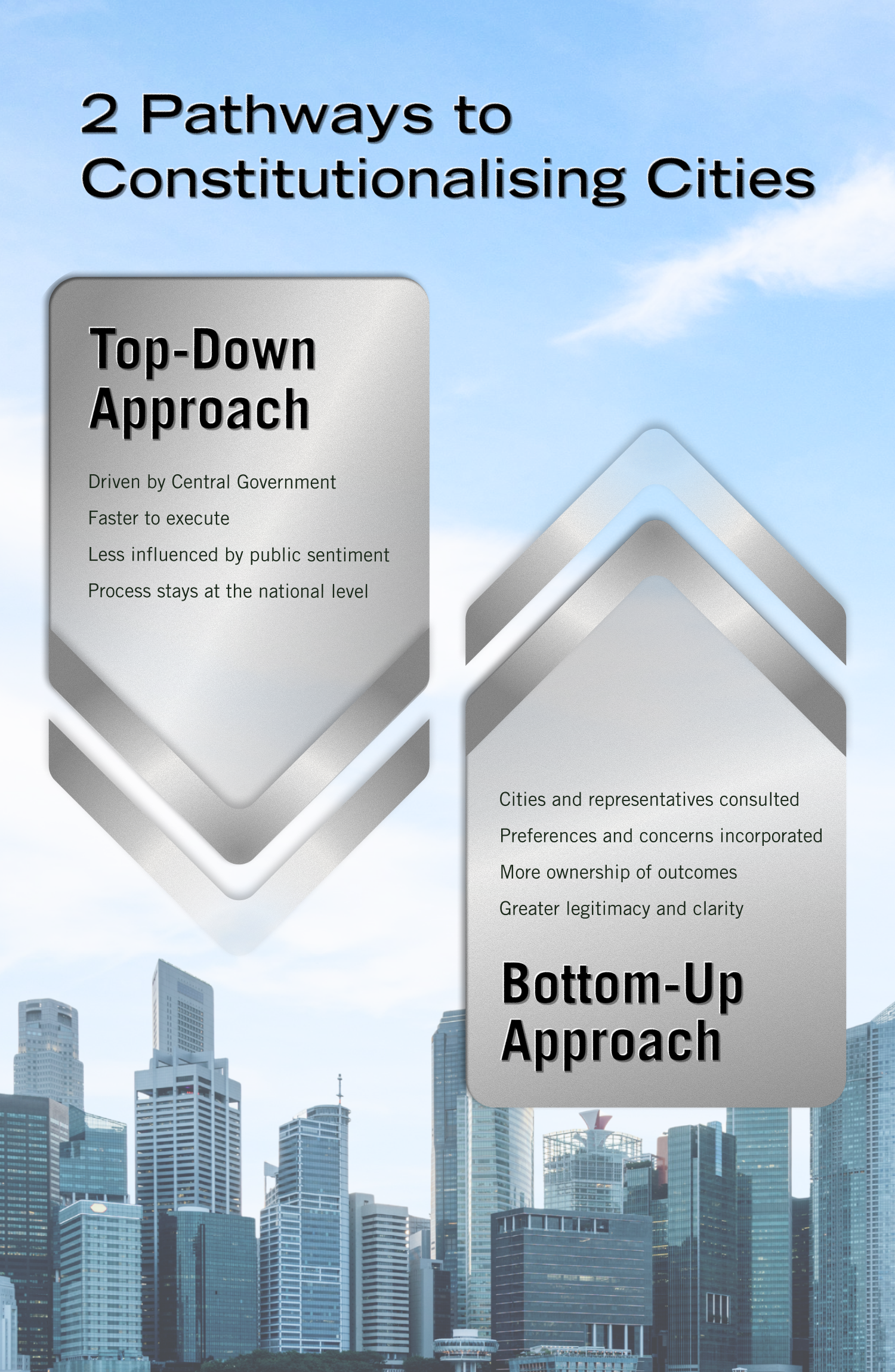
Prof Maartje De Visser: I think there are at least two approaches that can be imagined. One is a top-down approach and the other is a much more inclusive bottom-up approach.
Under the top down approach the central level takes the lead. So the government or the parliament accepts that the city should be recognised in the constitution. And then these national institutions go about preparing the necessary amendment and making that change to the constitutional text. This keeps the process quite centralised, at the national level. The advantages are that the process can be faster and it doesn't get potentially sidetracked or influenced by popular sentiments, or extraneous considerations.
Now the other way, and I think this would be the better way, is to have a more participatory process where you would speak with cities or their representatives to find out what they want to do, what their thoughts, concerns, preferences are, and what ideas they would like to have reflected in the legal or constitutional arrangements that are put in place. Having that kind of process would mean that you have a greater degree of ownership and legitimacy because it means that once a city is recognised in the Constitution, there will be greater clarity on what is expected from both the central level as well as the level of the cities.
Q: Is there a world where these two approaches could be blended together?
Prof Maartje De Visser: Just thinking aloud, one possibility could be when there is already a strong sense of what a city is. There can be very defined statements and ideas separating cities, from regions, from the rural areas. If that is pretty settled already, then it becomes a question of codifying the practice.
If the question is one more of codification rather than modification, that might make it easier to get alignment because people would say: We already have clarity on the existing arrangements. And if you run a consultative process along with a good public information campaign in a country that is not too large, then you might be able to have the best of both the top-down and bottom-up approaches.
Q: When constitutionalising a city, what principles or dynamics need to be prioritised?
Prof Maartje De Visser: Ideally, what we should see is not just a recognition that the state consists of the central level region and cities as well as municipalities, there should also be principles that govern the relationship between cities and other parts of the state structure. Now, ideally those principles should give sufficient space for city autonomy.
To be clear, cities are of course embedded within a wider state structure. So you can't imagine a city saying: you know what, we're going to chart our own course completely distinct from what the central level is doing. At the same time, what you see in certain European-level documents, for instance, in the Council of Europe Charter of Local Self-Government, are references to ‘local autonomy’.
I think that's important to say that you want to recognise at least two principles.
The first is subsidiarity. Subsidiarity at its core prescribes that decisions are taken as close as possible to citizens or individuals as possible. So that would mean that the central level only decides on those matters where consistency for the whole population is relevant or where economies of scale can be realised. But when it comes to the tailoring, you leave that to the cities. So subsidiarity matters.
The second principle that I think is key is loyalty. Loyalty should ideally be framed as mutual loyalty, meaning on the one hand that cities are loyal vis-a-vis the national level so that they can act as good and responsible implementation agents. For instance, imagine that there is new legislation on, say disaster management, then you can count on cities to make sure that this disaster management law is put into practice and that the necessary plans are adopted. On the other hand, institutions at the national level also need to show loyalty to cities by giving these actors sufficient space to do their own thing as well as sufficient resources to ensure that cities can actually fulfil their tasks.
Q: Your research focused mainly on the European region, how important is constitutionalising a city in Southeast Asia?
Prof Maartje De Visser: So I think that you could also make the argument that in Southeast Asia or Asia as a whole, there might be an even greater need to constitutionalise cities because some of these units are so large, so sprawling and have so much economic clout and relevance for the daily lives of millions of individuals that their legal and political recognition is critical.
Indeed, some of these cities have populations that exceed the number of people that live in small countries. It seems almost paradoxical that constitutions, at times, recognise regions but not specific cities. That's a real missed opportunity because these cities are responsible for the daily lives of millions of individuals, citizens and non-citizens alike. So if you think from the perspective of the people, where do they encounter the state? Well, you’d typically do that at the urban level when you apply for a permit, get a subsidy or participate in a demonstration. So interactions between individuals and the local government actually are more frequent, much more than interactions with national ministers or members of parliament.
Singapore is different because of its city-state character, but in many other Southeast Asian and Asian settings, the local level is the point of contact. If you recognise the city in the constitution, then it is also possible to put in place arrangements for making sure that these cities conform to democratic rules and principles. So by designating the city, you create another anchor for applying legal concepts and political ideas to this unit which is central to many people's lives.
Q: Are there countries that already mention cities in their constitution?
Prof Maartje De Visser: Italy is a very good example. Its Constitution mentions metropolitan cities and talks about subsidiarity. And talks about subsidiarity in a way that says individuals who live in cities can partner with the state or as well as private entities to develop new initiatives. So it's really about keeping decision-making close to the people.
In Ecuador, the Constitution recognises a right to the city or a right through the city, which means that city inhabitants can for instance use the public spaces to exercise their freedom of expression or freedom of assembly, so that they feel that the city is really a place that belongs to them.
Q: What are some takeaways that you want people to take away from your research?
Prof Maartje De Visser: One takeaway is that people need to think about the law when they reflect on cities and the urban setting. We tend to talk about them in sociological terms or economic terms. I think there is a greater need to say cities are also governed by laws, and cities therefore deserve recognition in the law.
The second takeaway is for policymakers to reflect carefully about what they consider to be the city in their respective country. So oftentimes we use the word the city without specifying what this means. As lawyers, that is actually a key challenge that we often confront. That's an important question for us to reflect on. To say, nationally speaking, what do we consider to be the city?
Third, I would want policymakers to say cities are more than just implementation agents for the national level. They are the last-mile in creating realities for government policies. Cities are the spaces where individuals encounter the state. Cities are social spaces and they are places where you can experiment with urban democracy and urban rights protection. So think about that social dimension of cities and we use them as laboratories to experiment with new approaches that can inform creative solutions that can benefit other levels of government.