
Are ‘green’ loans really good for the planet?: How Singapore can protect its biodiversity for a credible transition
Are ‘green’ loans really good for the planet?: How Singapore can protect its biodiversity for a credible transition
By SMU City Perspectives team
Published 19 February, 2026
“Weaving biodiversity into the fabric of finance will do nothing but enhance Singapore’s credibility as a transition finance leader.”
Maria Teresa Punzi
Senior Research Fellow, Sim Kee Boon Institute for Financial Economics, Singapore Management University
In brief
- The controversy over green loans for a housing development shows that meeting green finance rules is not the same as protecting the environment.
- The benefits of biodiversity are undervalued in current sustainability frameworks, leaving Singapore’s ecologically rich secondary forests vulnerable despite public demand for nature-positive development.
- To ensure credible leadership in transition finance, Singapore must adopt a unified, transparent biodiversity protection framework that aligns development, regulation, and finance with genuine ecological outcomes.
DBS and OCBC, two of Southeast Asia’s largest banks, and Hong Leong, a property developer, were called out through Substack recently over a ‘green loan’ they had provided for the development of a residential project in the Tengah area in Singapore. The S$692 million loan for the development would lead to the clearing of a forest in Tengah, home to various native flora and fauna.
According to The Business Times, DBS and Hong Leong have claimed that the development does not and will not include any primary forests in the region. All three parties also insist that the transaction met industry standards for green financing in real estate and complied with all regulatory requirements of the government land sales (GLS) programme.
The loan for the Tengah project highlights two things. First, compliance with established frameworks does not necessarily equal alignment with the wider ecological or social expectations. Second, biodiversity, despite its critical role in urban ecosystems such as Singapore's parks, forests, and reservoirs, remains underrepresented.
In this article, Dr Maria Teresa Punzi, Senior Research Fellow at SMU, explains how Singapore can build better safeguards for its green transition.
From Tengah to Dover: Value of Localised Ecological Wealth
“The recent controversy over DBS and OCBC’s S$692 million green loan to Hong Leong for a Tengah development has reignited an important conversation about what 'green' truly means,” says Dr Punzi. This development project, while technically compliant with the Singapore-Asia Taxonomy and international Green Loan Principles, involved clearing a secondary forest that is home to a diverse set of flora and fauna. The outcry and criticism from the public show that technical compliance with sustainability frameworks is not the same as efforts in genuine ecological protection.
Dr Punzi observes that this situation is similar to the Dover Forest episode, where citizen advocacy and ecological mapping highlighted the environmental and emotional value of what are essentially small green patches, in a case that was in the news between 2022 and 2023. “Both cases illustrate a growing public understanding that Singapore’s ecological wealth is deeply localised — found in secondary forests, scrubland, and microhabitats that sustain biodiversity across an intensely urban landscape.”
During the Dover Forest episode, citizen scientists documented over 120 bird species, rare butterflies, and mammals within 33 hectares of secondary forest. Eventually, it was public mobilisation, whether done through petitions, surveys, and nature walks, that led the government to adjust its planning, which then preserved most of the forest.
The Dover Forest debate showed that secondary forests have real ecological value. “Biodiversity in Singapore is intensely localised,” she explains, “and public trust depends on transparency. The debate showed that even areas classified as 'scrubland' can function as vital ecological corridors in an urban ecosystem.”
Climate-aligned but not nature-integrated
Dr Punzi studied the Dover Forest debate and came to the conclusion that Singapore’s frameworks for environmental protection may provide critical governance, but they remain fragmented and reactive.
From the National Biodiversity Strategy and Action Plan to the Parks and Trees Act and the Singapore Green Plan 2030, Singapore’s it is not mandatory for all developments involving habitat conversion to go through the Environmental Impact Assessment (EIA) process. And even if a development has undergone EIA, it is often not mandatory to publish the assessment report.
“The Singapore-Asia Taxonomy’s 'do no significant harm' principle sets a low bar for ecological protection. This climate-centric orientation reflects global sustainable finance trends, where carbon metrics dominate because they are easier to quantify and verify. However, biodiversity — being hyperlocal and complex — resists such simplification, requiring more nuanced and site-specific safeguards,” she says.
Click to interact
Learning from New South Wales
The question, in light of all this, is ‘what can Singapore do to improve its frameworks and safeguards to ensure biodiversity is protected? According to Dr Punzi, Singapore can draw lessons from the experience of New South Wales in Australia.
“Singapore can draw important lessons from New South Wales (NSW), Australia,” she says, “NSW’s Biodiversity Offsets Scheme (BOS) provides a robust structure for reconciling development with conservation. Under the scheme, developers quantify ecological loss using the Biodiversity Assessment Method and must purchase equivalent biodiversity credits to fund conservation actions elsewhere. The system is transparent, standardised, and overseen by the Biodiversity Conservation Trust.”
For Singapore, adopting a similar model could fulfil several objectives. For starters, this can help promote biodiversity enhancement in Singapore’s urban parks, road verges and vertical spaces despite our land scarcity. It can also offer objective, standardised methods for assessing biodiversity to minimise disputes over ecological value and help establish economic incentives for conservation. This will encourage and enable developers and agencies to earn biodiversity credits. Through a public registry of biodiversity credits, we can ensure transparency to the public.
In Dr Punzi’s view, this model should adopt the mitigation hierarchy to Avoid, Minimise, Restore, and only then Offset. This will help ensure that offsets do not become licenses for habitat destruction. To align climate and nature activities, it would help to set up a 'Singapore Biodiversity Credit Registry' under the National Parks Board, integrated with the Green Mark scheme and Singapore-Asia Taxonomy classification system launched by Singapore's central bank (MAS) in late 2023 to define what counts as "green" and "transition" activities for sustainable finance in Asia.As Singapore works to achieve its net-zero and sustainable finance goals, integrating biodiversity safeguards needs to become imperative for economic policy. As the Kunming-Montreal Global Biodiversity Framework and the Taskforce on Nature-related Financial Disclosures (TNFD) are transforming global finance by now requiring businesses to report on nature-related dependencies, impacts, risks and opportunities, Singapore must therefore adapt accordingly or be perceived as meeting formal requirements but lacking genuine commitment.
More importantly, she says, the expectations from the public have increased. The Dover and Tengah incidents show clearly that Singaporeans now regard biodiversity protection as part of the nation’s sustainability efforts. Neglecting our biodiversity means undermining both market credibility and public legitimacy in Singapore’s green transition.
Building a Biodiversity-Safe Finance Framework
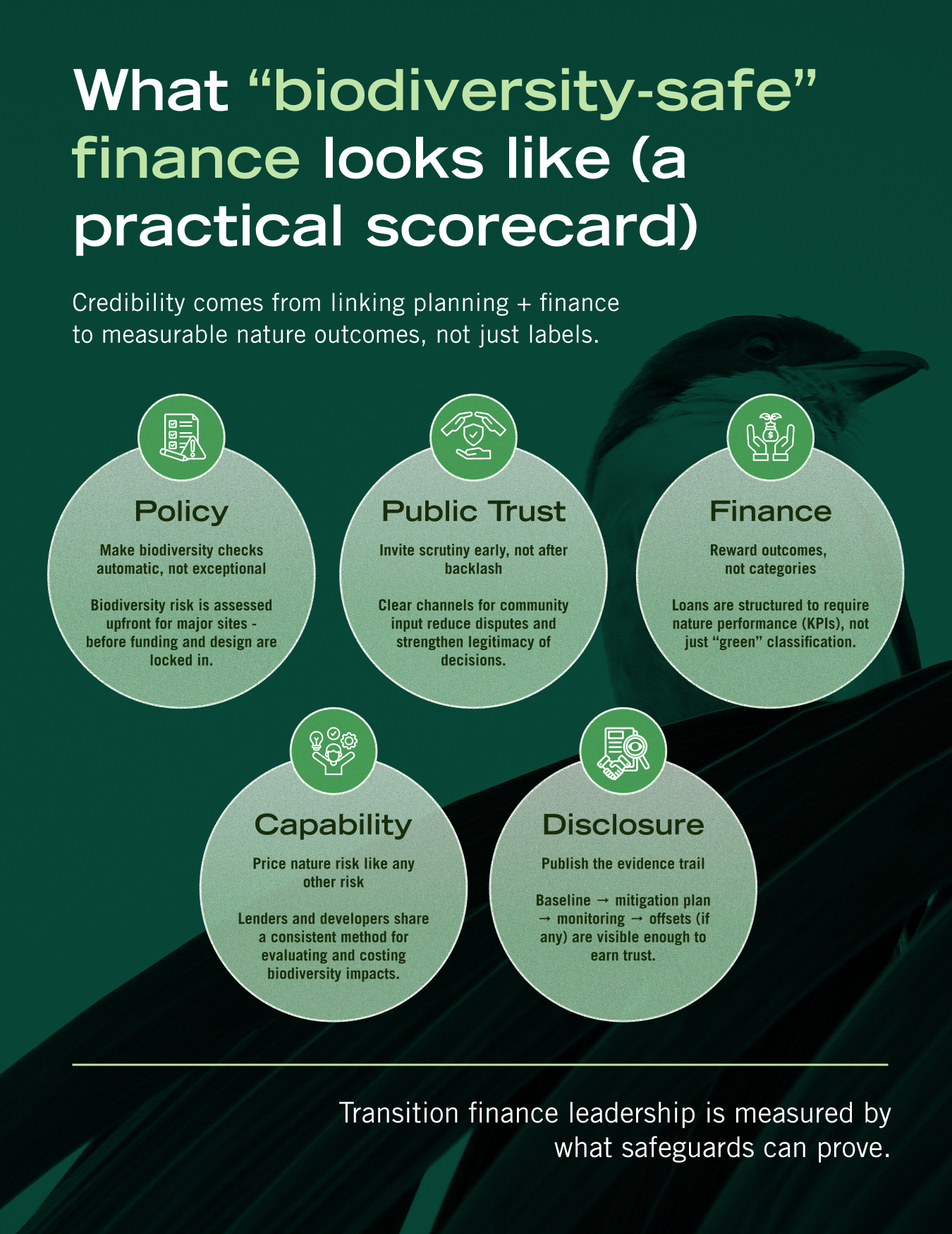
Dr Punzi also believes that in order to bridge the gap between climate and nature in finance, Singapore must establish a comprehensive Biodiversity Safeguard Framework that is rooted and focused on policy, finance, and public accountability. The Biodiversity Safeguard Framework can include:
- Policy Reform: Requiring transparent biodiversity impact assessments for all Government Land Sales (GLS) and major development projects; initiate a pilot Singapore Biodiversity Offset Scheme.
- Financial Innovation: Emphasising sustainability-linked loans rather than green loans for projects involving habitat conversion, incorporating measurable nature-related key performance indicators (KPIs).
- Disclosure and Transparency: Mandating the publication of ecological baselines, mitigation strategies, and offset measures associated with each green or transition loan.
- Institutional Capacity: Providing training for lenders, planners, and developers to evaluate and appropriately price biodiversity impacts and related risks.
- Public Engagement: Establishment of formal mechanisms for community involvement in environmental assessments and planning decisions concerning ecologically sensitive areas.
She says: “Weaving biodiversity into the fabric of finance will enhance Singapore’s credibility as a transition finance leader and set a regional precedent for integrating ecological integrity into economic growth.
“The Tengah loan debate should not be dismissed as an isolated controversy but recognised as a critical inflexion point,” she adds. “It revealed the limits of existing frameworks and the growing expectation of the increasingly well-informed public that 'green' finance must also be 'nature-positive.' By moving from compliance-driven sustainability toward a system of measurable biodiversity safeguards, Singapore can redefine what credible transition finance means — protecting not just carbon budgets, but living ecosystems.”