

Anxiety, Keep on trying me: A conversation with Associate Professor Andree Hartanto
Anxiety, Keep on trying me: A conversation with Associate Professor Andree Hartanto
By SMU City Perspectives team
Published 2 February, 2026
“This is why we need to continue supporting female students who may be more vulnerable to anxiety, while at the same time addressing the cultural and psychological barriers that discourage male students from acknowledging or seeking help for their mental health.”
Andree Hartanto
Full-time Faculty Assistant Professor of Psychology (Education); Lee Kong Chian Fellow
In brief
- The increasing prevalence of anxiety among college and university students has grown into one of the most pressing mental health issues on campuses today.
- Women may be more likely than men to report or seek help for anxiety, which could contribute to the higher observed prevalence. The results may also reflect underreporting by male students.
- Educational institutions and professors need to find ways to support students struggling with anxiety.
Anxiety, not just an incredibly popular Doechi song, but also a more prevalent occurrence among young adults in recent years. As time has gone on, more people have become more open about their struggles with anxiety and other mental health issues. This is especially prevalent among students.
The question becomes, what has caused this increase in anxiety, and what can educational institutions do to support students who are struggling? In this article, Associate Professor of Psychology Andree Hartanto discusses his Umbrella Review, conducted with Gabriel Tan, on the prevalence of anxiety among college and university students. The umbrella review synthesises findings from existing systematic reviews and meta-analyses, helping the researchers to understand the global prevalence of anxiety among college and university students. The paper has been cited over 100 times in two years.
Anxiety among university and college students
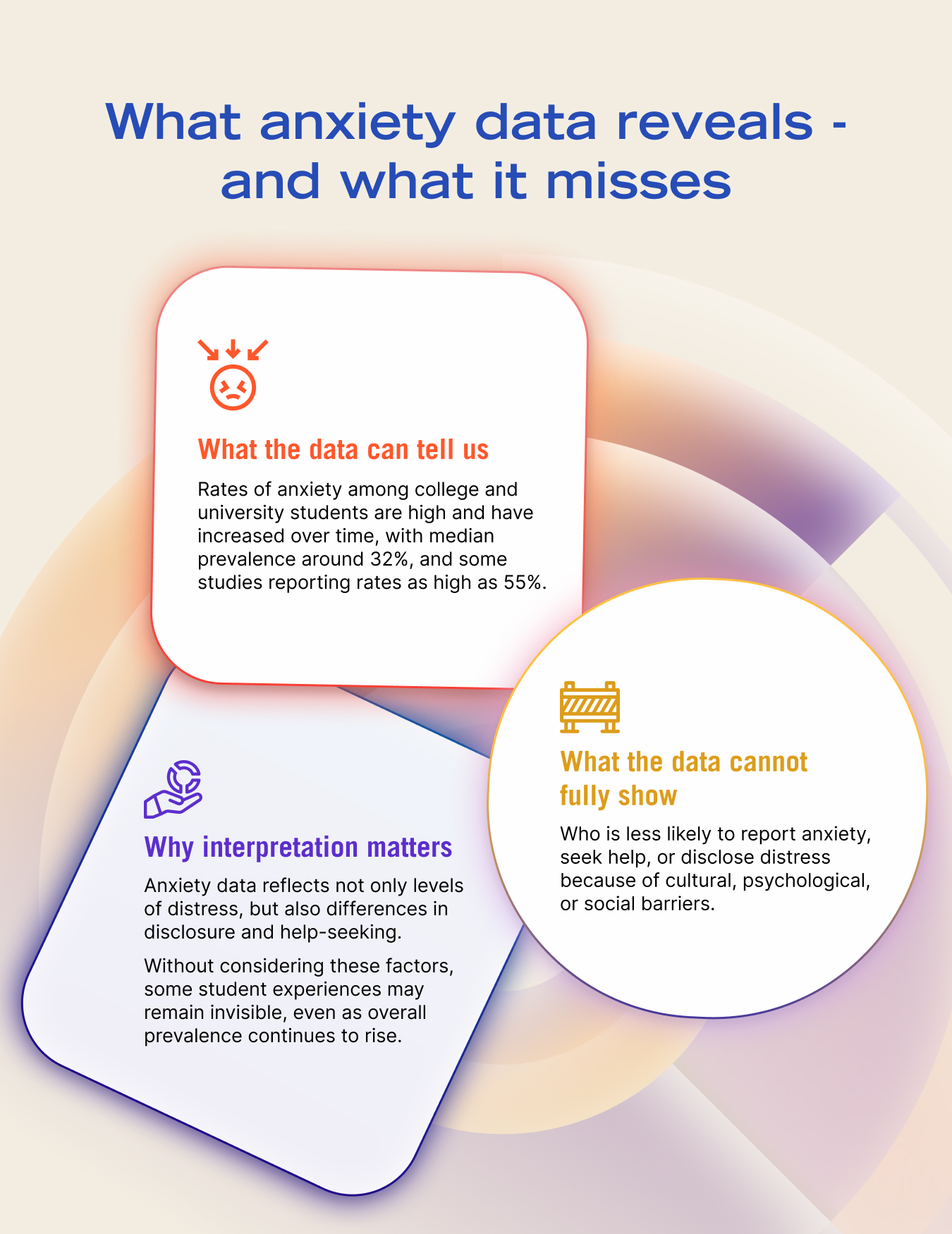
According to Assoc Prof Hartanto, the prevalence of anxiety among college and university students has increased steadily over the years, making it one of the most pressing mental health issues on campuses today. A review he did with Gabriel Tan, Psychology Student Researcher at SMU, found that the median prevalence of anxiety was around 32%, with some studies reporting rates as high as 55%.
More recent data from the review show that anxiety levels rose further during and after the COVID-19 pandemic, with notably higher rates in the later stages compared to pre-pandemic levels. Assoc Prof Hartanto highlighted several contributing factors during the COVID-19 pandemic, including the disruption caused by the sudden shift to online learning, social isolation, lack of face-to-face support, health-related fears, and financial strain. What this means is that the pandemic intensified both academic and personal stressors, making an already vulnerable population even more susceptible to anxiety during that period.
With continued pressures such as high expectations around multiple internships and increasing job market uncertainty, one could expect the prevalence of anxiety among students to remain high or even continue rising in the years ahead.
“Today's students are navigating a complex mix of academic, social, and economic challenges that can significantly heighten vulnerability to anxiety. There are many factors such as increasing academic and internship pressures, employment uncertainty, social and emotional stress, and fear of missing out from social media exposure.” he says.
Anxiety and gender
Assoc Prof Hartanto’s findings showed that female students generally reported higher levels of anxiety than male students. However, it is important to note that there could be different ways to interpret these findings.
“On one hand, consistent with existing studies, females may experience higher levels of anxiety due to a range of biological, psychological, and social factors. On the other hand, the results may also reflect underreporting by male students,” adds Assoc Prof Hartanto.
“In many cultural contexts, there is still a strong stigma around men expressing emotional vulnerability or seeking help for mental health issues. As a result, male students may be less likely to disclose symptoms or access mental health services, leading to an underestimation of their actual anxiety levels. This is why we need to continue supporting female students who may be more vulnerable to anxiety, while at the same time addressing the cultural and psychological barriers that discourage male students from acknowledging or seeking help for their mental health.”
The study also revealed that being female, living in Asia versus Europe, and being an undergraduate were associated with higher levels of anxiety.
According to Assoc Prof Hartanto, there are a few possible reasons behind these patterns. For female students, prior research has pointed to both biological and psychosocial factors, such as higher levels of social and academic pressures. It is also possible that women may be more likely than men to report or seek help for anxiety, which could contribute to the higher observed prevalence.
He explains that, for students in Asia, this may be due to more intense academic and societal expectations. In many Asian cultures, academic success is closely tied to family and personal identity, which may heighten pressure and fear of failure. There may also be less open discourse around mental health, which can increase internal stress even when external support is limited.
Anxiety manifested among academic levels
The review did find that undergraduate students consistently showed higher levels of anxiety compared to graduate students. “This may be because they are still adjusting to the transition to adulthood, managing academic demands, and navigating new social and financial responsibilities,” explains Assoc Prof Hartanto. In contrast, postgraduate students are typically more experienced and may have developed stronger coping mechanisms and a clearer sense of direction.
“While students in medicine, nursing, and other health-related fields are often highlighted due to their high anxiety levels, I believe that rising anxiety is a broad-based phenomenon that extends beyond healthcare students.”
University students feel ‘anxious, confused and distrustful’ about AI in the classroom and among their peers. Assoc Prof Hartanto’s review also found that students from low socioeconomic backgrounds often face additional stressors, such as financial insecurity, fewer safety nets, and the need to balance studies with part-time work.
Helping students cope better
So the question becomes, what types of interventions have been most effective in reducing anxiety among college and university students? And what can educational institutions do to address this increase in anxiety?
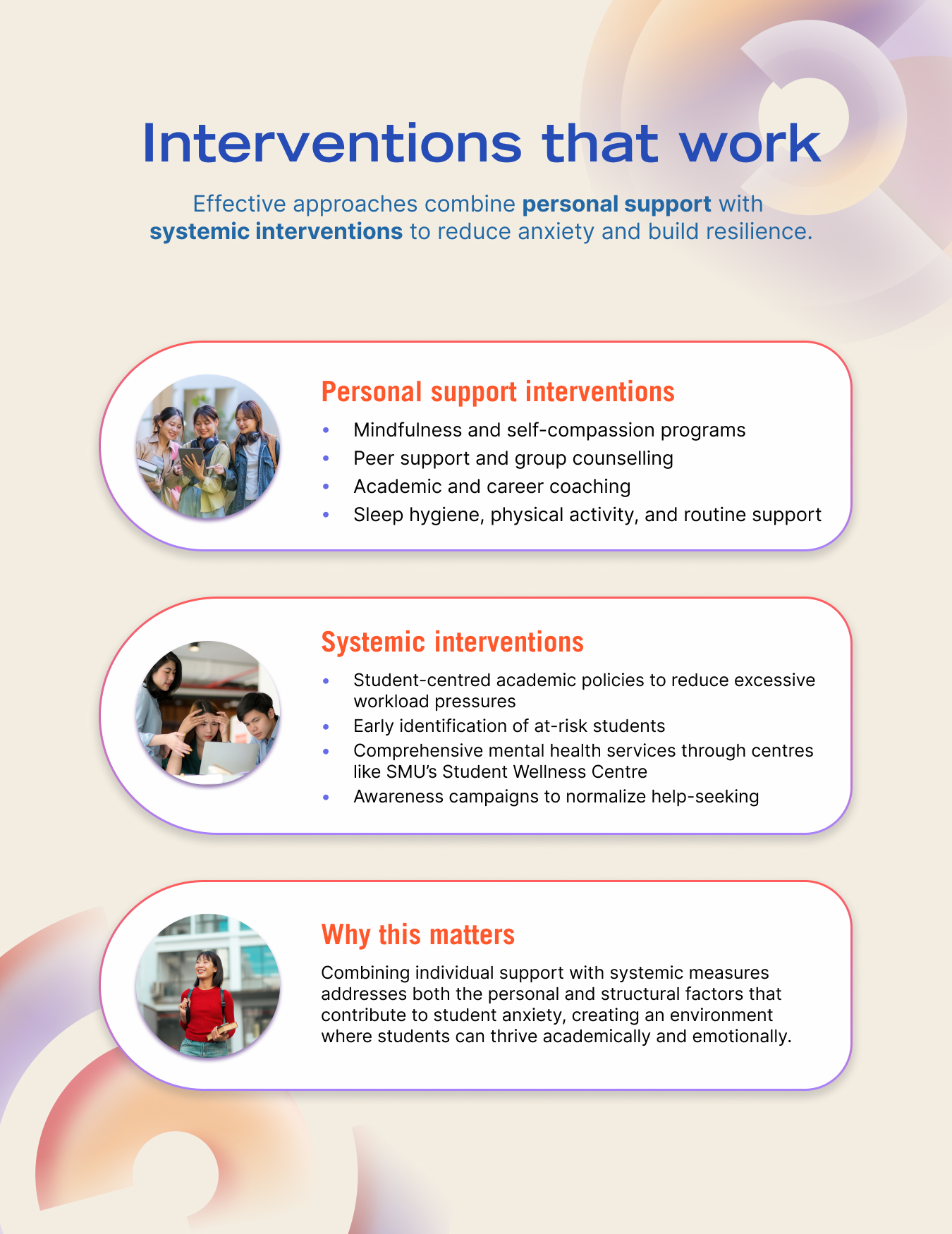
According to Assoc Prof Hartanto, a variety of interventions have proven effective in reducing anxiety among college and university students, especially those that are accessible, scalable, and responsive to students’ everyday challenges. From Mindfulness programs to mental health workshops to peer support initiatives, and group counselling, these normalise help-seeking and provide emotional support in low-barrier ways. Academic and career coaching services can also play a role by easing anxiety related to performance and post-graduation uncertainty through practical guidance.
“Over the past two years, we have been collaborating with the SMU’s Mrs Wong Kwok Leong Student Wellness Centre and found that separate interventions targeting sleep hygiene, self-compassion, and physical activity have each been helpful in improving well-being among students.”
Educational institutions also play a critical role in addressing the rise of anxiety in students.
“At the systemic level, they can invest in comprehensive mental health services, normalise help-seeking through awareness campaigns, and embed well-being into campus culture. A good example is the initiative by SMU through the Student Wellness Centre, which provides a range of proactive and student-centred programs to support emotional well-being.” Says Assoc Prof Hartanto.
He adds that universities could adopt student-centred academic policies, reduce excessive workload pressures, and implement intervention systems that identify and support at-risk students early. Professors also have a part to play. They can create psychologically safe classroom environments through being approachable, empathetic, and responsive to students’ needs.
At the end of the day, it is clear that students today are trying to navigate a complex mix of academic, social, and economic challenges that are thrown their way. Educational institutions play a critical role in addressing the high prevalence of anxiety among students. At a systemic level, Assoc Prof says “they can invest in comprehensive mental health services, normalise help-seeking through awareness campaigns, and embed well-being into campus culture. A good example is the initiative by SMU through the Mrs Wong Kwok Leong Student Wellness Centre, which provides a range of proactive and student-centred programs to support emotional well-being. Universities can also adopt student-centred academic policies, reduce excessive workload pressures, and implement early intervention systems that identify and support at-risk students in a timely and inclusive manner.”
Methodology & References
TAN, Gabriel Xing Da, SOH, Xun Ci, HARTANTO, Andree, GOH, Adalia Yin Hui, & MAJEED, Nadyanna M..(2023). Prevalence of anxiety in college and university students: An umbrella review. Journal of Affective Disorders Reports, 14, 1-15. Available at: https://ink.library.smu.edu.sg/soss_research/3830