
The Green Skills Gap: What’s Missing and How to Fix It
The Green Skills Gap: What’s Missing and How to Fix It
By SMU City Perspectives team
Published 31 March, 2026
“Green transitions are already well underway in many countries. Policymakers, employers and universities should be paying close attention to the green skills gap, because it is a loosely defined yet critically important policy priority that threatens to become unmanageable the longer we wait to address it.”
Ishani Mukherjee
Associate Professor of Public Policy
In brief
- Climate change and the shift towards a net-zero economy pose significant risks to jobs globally unless workers are equipped with green skills and competencies.
- There is already a green skills gap in the labour market that will only widen over time if it is not addressed.
- Comprehensive and coordinated policies must be developed to define and measure green jobs and skills, enhance educational offerings, and provide support for workers and employers during the transition.
The transition to a net-zero economy is a conversation that comes up every year as the world gets closer to the UN’s sustainability targets of 2030. Whether the world is closer to achieving those goals or not is a whole other conversation, but what is certain is that the transition and climate change are going to profoundly affect the world of work. About a quarter of all jobs around the world are highly vulnerable, especially those in the Asia Pacific, according to an article by Panchali Guha. Dr Guha is a Senior Research Fellow at the School of Social Sciences, and her collaborators are Assistant Professor of Sociology Annika Rieger and Associate Professor of Public Policy Ishani Mukherjee.
In this article, Mind the Green Skills Gap, Dr Guha observes that there is a significant risk of job losses in the short and medium term unless workers can be swiftly reskilled and redeployed in new industries and occupations. As more and more parts of the world commit to their net-zero emissions targets, this demand for green skills will increase. “In the longer term, the green economy has the potential to generate significant economic growth and job creation, with some estimates forecasting the creation of 300 million additional jobs by 2050,” she notes.
Here, Dr Guha, Asst Prof Rieger, and Assoc Prof Mukherjee discuss what green skills are and why it is important to invest in developing them.
What are ‘Green Skills’?
There is currently no universal definition of ‘green skills’. Generally, they can be understood as “the knowledge, abilities, values, and attitudes needed to live, work, and act in economies and societies seeking to reduce the impact of human activity on the environment”, said Dr Guha. “One thing that is for certain is that they are essential for the performance of green jobs.
The transition into a green economy will create new jobs and change the demand for several existing ones.”
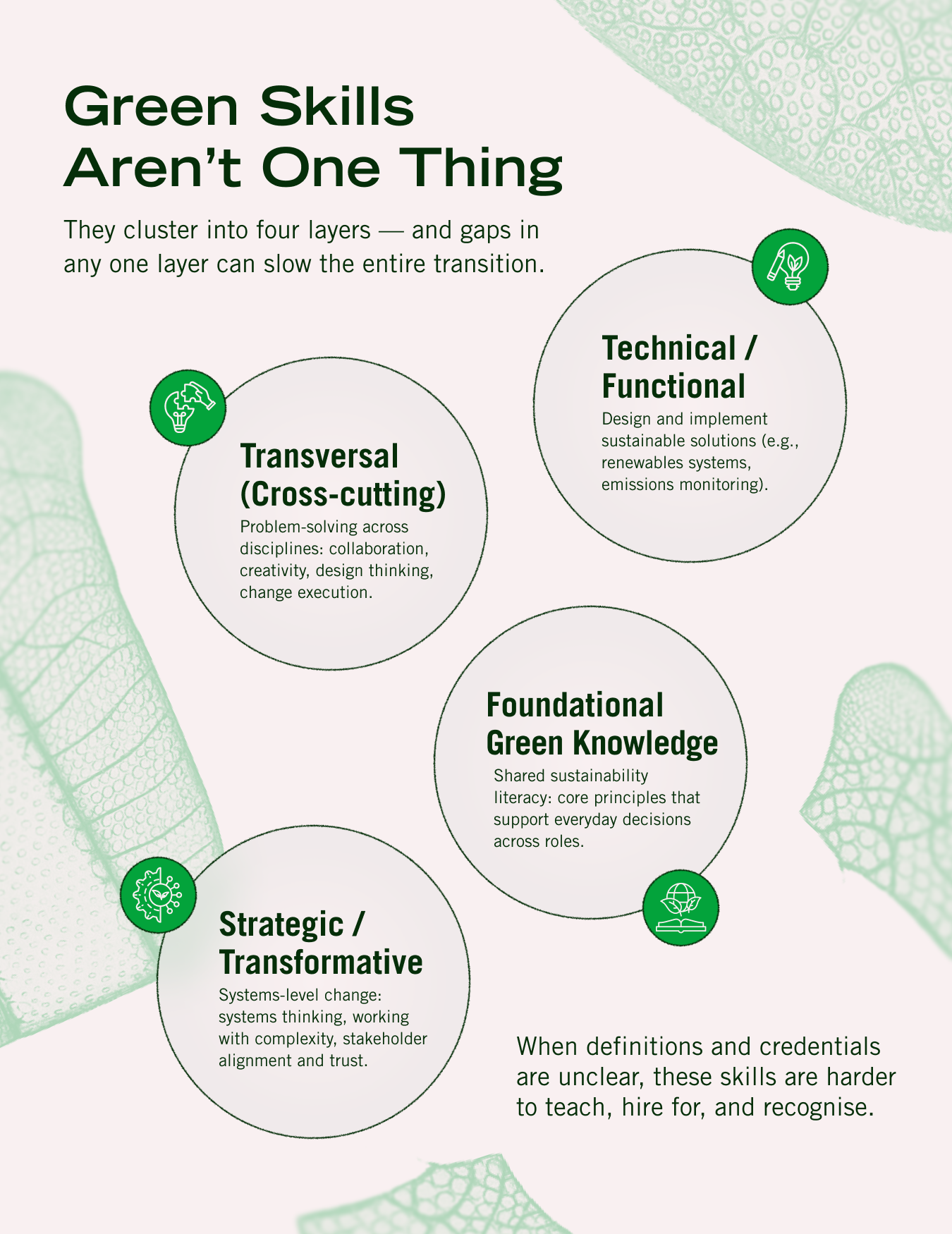
Because there isn’t a simple answer to how to define green skills, the team conducted a systematic qualitative analysis of 16 key documents that offered a definition or competence framework of green skills last year, and found that the documents collectively refer to four key categories of skills. These are:
- Technical or functional skills: These are required to design and implement sustainable solutions. Workers need such technical skills to design a renewable energy system, for instance, or to correctly monitor emissions.
- Transversal skills: These refer to cross-cutting skills required to design and implement sustainable solutions. These can include cognitive processes such as design thinking or non-cognitive abilities such as creativity and collaboration.
- Foundational green knowledge, or general scientific understanding of sustainability principles, that everyone across the workforce and wider society needs to have.
- Strategic or transformative skills: Vital for driving systems-level change and transformation. This includes skills like systems thinking or working with complexity, but also for stakeholder engagement, so that different people are able to co-create solutions, build credibility in a collaborative manner.
Examples of how green skills are reshaping day-to-day work can be seen both in the emergence of entirely new roles and in the way long-standing professions are adapting. Roles such as ‘Chief Sustainability Officer’ or ‘Sustainable Finance Specialist’ were rare—or in many organisations simply did not exist—a few decades ago, yet they are now increasingly common as sustainability becomes a core business priority. At the same time, green transitions are also changing what familiar jobs look like: chefs, for instance, may now be expected to craft vegetarian or vegan menus and develop zero-waste approaches to cooking. In these cases, the core function of the role remains largely the same, but the skill set required to perform it well has evolved.
How to Establish Credibility of ‘Green Skills’
Because of the lack of a clear, consistent, and widely adopted definition of green skills, there is no clear way to understand what and where the green skills shortage is. But, Asst Prof Rieger says it would be fair to say that there are scarcities in all areas, and a scarcity in just one of these areas has cascading effects on the others. “For example, the shortage of green credentials makes it harder for employers to hire qualified people for green jobs,” she shares. “Instead, some employers have told us that they have focused on hiring people with job-specific skills and an interest in sustainability, and then a lot of the employees’ green skills must be learned on-the-job.”
In addition, because of the lack of recognised green credentials, employees with green skills often face challenges when trying to effectively demonstrate their abilities to potential employers. As a result, they find themselves resorting to indirect methods, such as highlighting sustainability-related coursework or volunteer experience.
Establishing the credibility of a credential takes time. There needs to be some level of hiring success and retention to prove that a certain qualification is a good signal of a specific skillset. On top of that, to create a credential, there needs to be clarity around which skills are needed to complete these jobs, and which skills are valuable to employers.
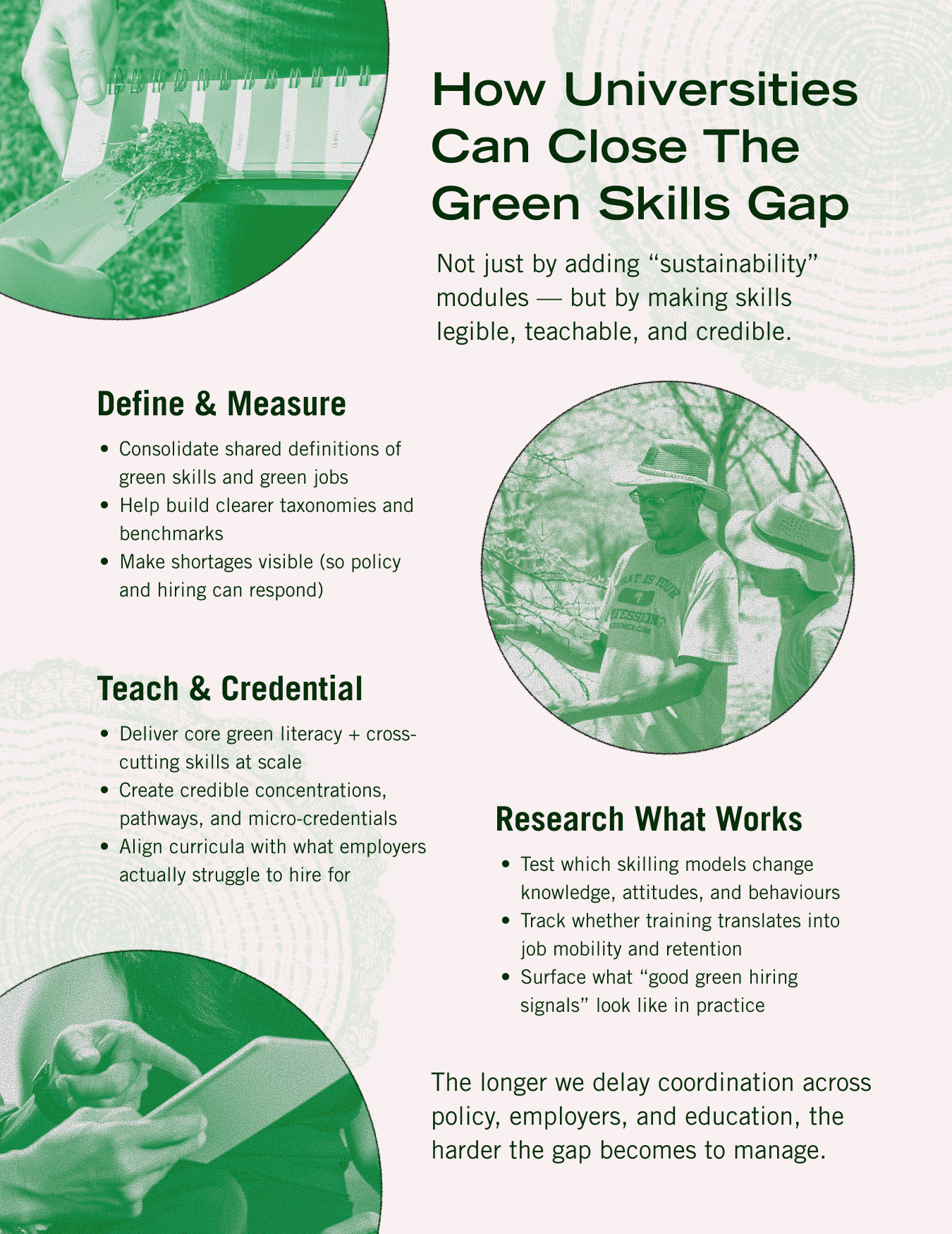
Asst Prof Rieger elaborates: “My colleagues and I believe that clarifying skills and providing credentials is a good place to start addressing the green skills shortage. It can help potential employees signal their skills, and when employers hire them, but it can also help attract more people to learn these skills. A credible credential proves that there is demand for green skills and thus can help encourage people to meet that demand. But credentials must be informed by what skills employers are looking for, skills that they feel are not available in the labour market. And it must be informed by students, and the skills they feel they need to acquire.”
Do universities have any role in identifying and filling the green skills gap in any way?
Robust policies on education, training, and skills development are essential if governments want to address the challenges and capitalise on the opportunities presented by the transition to a green economy. With appropriate support, workers in roles that are being phased out can also be redeployed into comparable positions within other industries, and students can be trained and equipped with green skills to take on this new landscape.
“Universities are key players in addressing the green skills gap on both fronts,” says Asst Prof Rieger. “In terms of identifying the green skills gap, we think the first step is to consolidate a clear definition of green skills to be used by policymakers, educators, and employers. With a clear definition, we can better identify not only the gap but also help to fill it. Universities are also ideal places to provide green skills, especially the soft skills that we believe are so important to a green skill set. And they can help back up the credibility of these skills by providing concentrations in sustainability areas, so that students can clearly communicate their abilities to employers.”
Where are ‘Green Skills’ in Demand in the Economy?
“Universities are also research hubs,” adds Dr Guha, “and have a huge role in helping us to better understand how ‘green skills’ are actually contributing to the economy. How effective are different green skilling models in enhancing the sustainability-related knowledge, attitudes, and behaviours of participants? To what extent do they help participants to make the transition to green jobs and thereby close the gaps in the labour market? On the employer side, what specific kinds of skills, knowledge, and certifications are employers looking for when they prioritise green hiring? These are just a few of the questions that data-driven research can help answer.”
“Green transitions are already well underway in many countries,” says Associate Professor Mukherjee. “Policymakers, employers and universities should be paying close attention to the green skills gap, because it is a loosely defined yet critically important policy priority that threatens to become unmanageable the longer we wait to address it. This is not a simple or singular issue of finding new jobs and roles for those whose current work would be impacted or transformed due to green transitions, as there are deep equity repercussions at play here.”
However, the team stresses that this is not a one-to-one mapping of all professions. Some jobs, such as those in heavy industry, construction, project management and electrification, can involve people who have core competencies that make them somewhat sector-agnostic and who can be readily reabsorbed in parts of the economy that need to be scaled up for sustainability. Where it gets harder is when a professional has expertise or skill sets that are heavily linked with a specific technology or sector that could decline as countries realise their sustainability ambitions. Workers in extractive industries may fall into this category and may be at risk of direct displacement.
‘Plug-and-Play’ or Differentiated Skills for Different Roles?
Associate Professor Mukherjee stresses that green transitions are not simply a matter of adding a ‘plug-and-play’ set of skills to existing jobs. Instead, she argues for a more considered discussion about the different kinds of green skills required across professions and levels of seniority—from building design, management and operations to business functions such as finance and transition finance—because what counts as ‘green capability’ looks very different depending on the role and the decisions a person is responsible for. “But where universities are key catalysts in this time of transition, it is specifically for a second category of professionals from sectors that are adjacent to ‘green’ sectors, and who may be indirectly impacted if they are not able to gain knowledge and aptitude within the green economy to be able to capture good jobs within it.”
She explains: “For some individuals, this may mean ‘upskilling’ in some compartmentalised, narrowly defined skill set as a ‘top-up’ to their core competence. For example, architects need specialised training about green building certifications, or accountants need carbon accounting and ESG reporting capabilities. For others, it is the need to acquire a broader, systemic understanding of what sustainability means in order to navigate how they pivot and evolve in their careers. One example is the awareness of just transitions by people in management or recruitment roles, which signals a steady but wholesale change in the way their work is done, rather than thinking of it as a simple plug-and-play set of green skills.”
Investing in green skills now is not simply a workforce policy—it is a bet on resilience in disruptive and unpredictable times. As climate risks intensify and economies retool, the capacity to design, measure and deliver sustainability outcomes will shape which industries thrive, which workers are protected, and how credible our climate commitments ultimately become. In that sense, closing the green skills gap is as much about planetary health as it is about jobs.
Methodology & References
GUHA, Panchali. Mind the green skills gap. (2025). Asian Management Insights. 12, (1), 60-67.
Available at: https://ink.library.smu.edu.sg/ami/282