
WORLD CITIES SUMMIT 2026
Can Cities Truly Green Data Centres: A Value Chain Approach
Background
Global demand for data centres (DCs) has skyrocketed in the last decade and is projected to grow exponentially. However, the life-cycle impacts of DCs are often overlooked. Beyond energy- and carbon-intensive operations, upstream and downstream impacts from material sourcing to retirement and decommissioning may undermine the sustainability gains of green digital innovations.
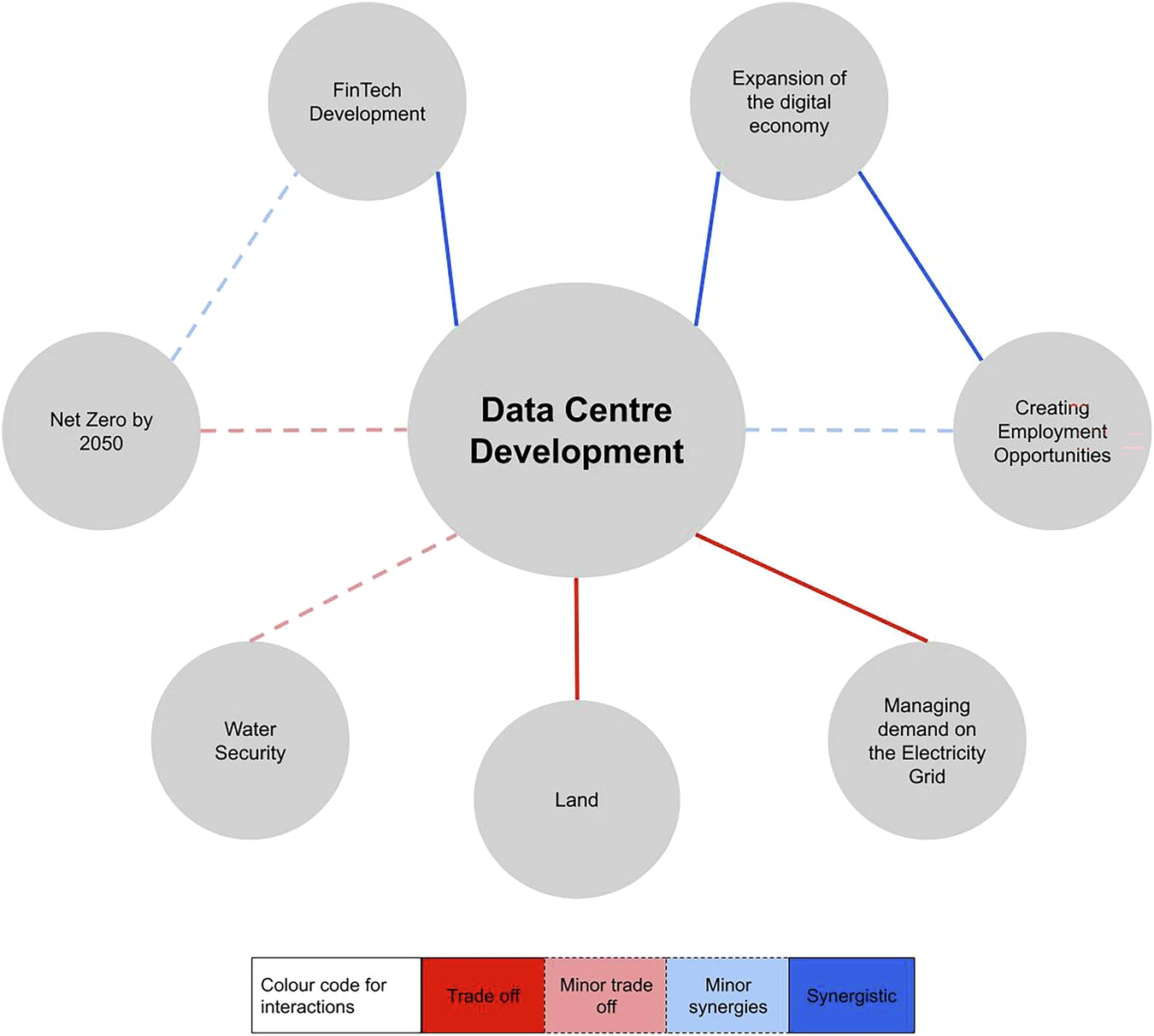
While the rise of DCs in Singapore and across the region encourages the growth of FinTech and the digital economy, this places significant strain on energy, land and water resources and jeopardises Net Zero commitments. What is needed is a careful balancing of economic and environmental trade-offs while maximising positive outcomes.
An Ecosystem-wide Approach to Greening DCs
To navigate the trade-offs in decarbonising the DC sector, this study by the Singapore Green Finance Centre (SGFC) at SMU, developed in collaboration with multiple institutions, identifies five pillars of the green data centre value chain that require significant investment and coordination, with examples from Singapore.
Technological innovation
Technological innovation is key to improving the resource efficiency of DCs in Singapore. One major strategy is reducing cooling demand by operating data halls at higher ambient temperatures, with Singapore introducing new standards supporting temperatures of 24–31°C range instead of the current 18–22°C range.
Innovation across buildings, materials and software also plays an important role in a sustainable DC transition. New facilities should incorporate low-carbon, climate-resilient materials, while retrofitting should prioritise extending asset life and minimising embodied carbon emissions. At the same time, software efficiency can lower energy consumption and reduce waste through better coding practices, while also improving power and temperature management and enabling more effective monitoring of energy use and carbon footprints.
Policy and regulation
Government policies and regulations play an important role in shaping a sustainable DC sector by establishing common standards and minimum sustainability requirements. In Singapore, measures such as the temporary DC moratorium allowed time to develop stronger regulatory frameworks, while new standards require DCs to achieve a design Power Usage Effectiveness of 1.3 or below, obtain Platinum certification under Singapore’s Green Mark for DC criteria and provide evidence of a clear pathway to achieving 100% renewable energy.
However, strict regulations may shift development to neighbouring countries with looser requirements, potentially displacing environmental impacts rather than reducing them. One compromise is to adopt “soft” regulation in the form of voluntary standards and guidelines, which represent international industry best practices and have greater flexibility than statutory mandates.
Finance
Greening the DC value chain is highly capital-intensive, creating strong opportunities for sustainable finance. The most common instruments are green bonds and project financing for new DCs, tied to energy efficiency, renewable energy use and green building certifications. Private equity also plays a key role in early-stage development, often enforcing stricter sustainability standards due to their significant ownership stakes.
However, most of this financing flows to greenfield projects. By contrast, brownfield assets receive far less sustainable investment. This is a missed opportunity given the large stock of existing DCs, especially in hubs like Singapore. Sustainability-linked loans at the operational stage could help close this gap by rewarding improved performance through lower interest rates, while stronger mechanisms, such as annual sustainability-linked reviews and penalties for underperformance, could improve accountability. Financial institutions also benefit from these instruments as they align with their own climate commitments, creating mutual incentives for wider adoption.
Infrastructure
Traditional financial centres often double as DC hubs due to strong governance, investor availability, professional services and reliable infrastructure. However, Singapore’s competitive edge may gradually weaken as regional connectivity improves. At the same time, Singapore’s physical constraints limit renewable energy generation, meaning most DCs rely on virtual power purchase agreements and renewable energy certificates to claim 100% renewable sourcing, raising concerns about credibility and reputational risk.
As a result, there is growing pressure to develop more tangible renewable energy solutions and stronger regional integration. A key long-term strategy is greater ASEAN-wide cooperation to build a regional renewable energy grid that enables cross-border clean energy imports. Yet, this faces significant coordination challenges, including investment alignment, governance structures, technical integration and equitable benefit-sharing across countries.
People
The sustainability transition of Singapore’s DC sector requires a suitably skilled labour market, but the industry is still in the early stages of defining what a “sustainable DC” entails. A key barrier is a shortage of specialised sustainability expertise, compounded by a lack of standardised training and certification compared to sectors like oil and gas. Government and industry efforts, including subsidised training programmes such as DC engineering courses offered by the Institute of Technical Education and Microsoft’s Data Centre Academy, are beginning to address these skills gaps.
Beyond workforce development, stronger knowledge-sharing platforms and industry coordination — potentially through industry associations — could help better align stakeholders, improve stewardship and support a more cohesive sustainability transition. To date, SG Tech and the Singapore Computer Society have led early efforts.
Policy and Industry Suggestions
-
Comprehensive assessment of the environmental credentials of DCs
Considering the complexity of the DC value chain, there is a need for greater regulatory, industrial and investor attention on environmental criteria that are under-adopted or overlooked by existing standards or taxonomies.
-
Policy and regulatory support
Singapore’s BCA-IMDA Green Mark for Data Centres and the Singapore-Asia Taxonomy for Sustainable Finance use market-based approaches to regulate environmental performance and guide sustainable investment in the sector. These offer a transferable model for other DC hubs, but require further refinement to fully integrate lifecycle emissions and align sustainability across the entire DC value chain.
-
Training sustainability capacity within the digital ecosystem
Governments and trade associations of DCs, hardware and software engineering and building sectors should continue to collaborate to establish sectoral skillsets and training programmes for students and professionals to enhance awareness of the latest DC sustainability best practices. Building a collaborative sustainability talent pipeline can also help to overcome the existing risk-averse industry culture in the DC sector.
-
Role of DC operators
DC operators should disclose and manage targets and progress in reducing environmental impacts, extending efforts beyond energy efficiency to Scope 3 emissions across suppliers and clients through engagement, screening and incentives. They can also prioritise decarbonising brownfield assets via retrofit evaluation and emissions trade-offs, and work with banks and investors to align refinancing with measurable sustainability improvements, strengthening incentives for greener operations.
-
Role of Investors
Investors should regularly update sustainability expectations in line with new low-carbon technologies, moving beyond a narrow focus on energy efficiency to a full value chain-wide transition. As shareholders or creditors, they can hold DCs accountable through credible, science-based transition plans with regular reporting and audits. They should also explore bundled investments across renewable energy, infrastructure, hardware and software, requiring greater coordination and alignment among institutional investors across the DC value chain.
Conclusion
Lead researcher Professor Winston Chow says: “Sustainability in digital infrastructure will not happen by accident. It requires deliberate alignment of policy, finance, technology, infrastructure and education, guided by rigorous lifecycle metrics. In place of regulatory patchwork, greening DCs requires an ecosystemic, value chain-wide strategy that ensures the digital economy supports, rather than undermines, climate goals.”

SMU Researcher:
Winston Chow
Lee Kong Chian Professor of Urban Climate, SMU College of Integrative Studies;
Pillar Lead, Urban Systems, SMU Urban Institute;
Lee Kong Chian Fellow
Collaborators:
- Felicia Liu, Senior Lecturer in Sustainability, Department of Environment and Geography, University of York
- Karen Lai, Professor in Economic Geography, Durham University
- Bertrand Seah, Sustainability Consultant, Paia from CBRE
Funding organisation: Singapore Green Finance Centre
Read more about this study: Decarbonising digital infrastructure and urban sustainability in the case of data centres